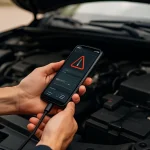


The engine management light never comes on at a convenient time. It pops up on the school run, halfway to work, or the night before a long motorway trip – and suddenly you are weighing up risk, cost, and whether you will end up in limp mode.
An engine management light diagnostic service is not just “plugging in a code reader”. Done properly, it is a structured fault-finding process that tells you what has failed, what is causing it, and what needs doing next so you do not waste money swapping parts.
What the engine management light is actually telling you
Modern cars are constantly checking sensors, airflow, fuelling, emissions systems, boost control, ignition, and a long list of plausibility values in the ECU. When something falls outside expected limits, the ECU logs a fault and may switch the light on.
The key point is this: the light is a symptom, not a diagnosis. A single fault code can have multiple causes, and the “most common fix” you see online is often just the most common guess.
A flashing engine management light is different. That usually indicates an active misfire that can damage the catalytic converter. If it is flashing, stop driving if you can do so safely and get it checked immediately.
Why cheap code reads often don’t solve the problem
A quick scan at the counter or with a basic handheld reader can be useful, but it often leaves out the information that matters: live data, freeze-frame data, readiness monitors, manufacturer-specific codes, and the context around when the fault was set.
The result is predictable. People replace an EGR valve because the code mentions EGR flow, then the light comes back because the real issue was a split vacuum hose, a sticking actuator, carbon restriction in the intake, or a DPF regeneration problem throwing the system out of range.
If your goal is to fix the fault once and not keep paying for “attempts”, you need a diagnostic approach that links the code to test results.
What a proper engine management light diagnostic service includes
A professional diagnostic appointment typically starts with the basics, then gets more specific based on what the ECU is reporting.
You should expect a technician to confirm the complaint and warning behaviour, then carry out a full fault scan across relevant modules (not only the engine ECU). From there, the job becomes evidence-led. Freeze-frame data shows the conditions at the time the fault occurred – load, RPM, coolant temperature, boost request vs actual, and more. Live data then confirms what is happening right now.
The most valuable part is not the code list. It is the interpretation: what is most likely, what is testable, and what should be ruled out before any parts are fitted.
The difference between a fault code and a fault cause
Fault codes are written to help technicians narrow a problem down, not to name the failed part. For example, an underboost code might be caused by a boost leak, a sticking turbo actuator, a split intercooler hose, a tired boost control solenoid, a clogged air filter, a sensor reading incorrectly, or even restricted exhaust flow on some setups.
This is why a good diagnostic service follows a chain: code – data – inspection – test – confirmation.
Common reasons the light comes on (and what they usually feel like)
There are patterns we see regularly on modern petrol and diesel engines, especially on higher-mileage vehicles and cars doing lots of short trips.
DPF-related faults tend to show up as reduced power, a fan running after shut-down, frequent regeneration attempts, or limp mode on a motorway incline. Short journeys and stop-start use can prevent a full regen, and once soot load is too high, the car may not be able to recover without targeted intervention.
EGR and intake issues often feel like hesitation, flat spots, or inconsistent low-end pull. Carbon build-up can restrict airflow and distort sensor readings, which then cascades into other faults.
Misfires on petrol engines are commonly felt as shaking at idle, poor acceleration, or a flashing light. Causes can be as simple as worn spark plugs or a coil pack, but you still want data-backed confirmation because fuelling and air leaks can mimic ignition faults.
Sensor-related faults (MAF, MAP, lambda, temperature sensors) can cause poor MPG, rough running, and intermittent warnings. Sensors do fail, but wiring, contamination, air leaks, and out-of-range readings caused by other issues are all on the table.
The “it depends” scenarios that change the diagnosis
Two cars can show the same light for completely different reasons. That is why the most honest answer in diagnostics is sometimes “it depends” – but it should always be followed by what the technician will do to remove uncertainty.
If the fault is intermittent, the car might drive perfectly during the appointment. In that case, the focus shifts to stored history, freeze-frame, and patterns in the data. A sensible plan might include checking for known weak points, looking for early signs of leaks or poor connections, and advising what to monitor.
If the car has recently had work done, you have to consider disturbed connectors, incorrect parts, vacuum routing errors, or adaptation values that need relearning.
If the vehicle has been remapped previously, it matters whether it was custom-calibrated for that exact car and software version, or a generic file. Poor calibrations can trigger plausibility faults or stress components. A careful diagnostic process separates true hardware failure from calibration or control issues.
What happens after the diagnosis
Once the cause is identified, the next step should be a clear set of options. Sometimes it is a straightforward repair. Other times, it is a staged approach where you start with the most likely and most cost-effective fix, then re-test.
You should also expect straight talking about urgency. Some faults are “fix soon” because they affect economy and emissions but are unlikely to strand you tomorrow. Others are “stop now” faults because continued driving risks engine damage, turbo damage, or aftertreatment failure.
A good diagnostic service also considers prevention. If the light is on due to DPF loading or intake restriction, resolving the immediate fault without addressing the underlying driving pattern or maintenance issue just sets you up for a repeat visit.
Mobile diagnostics: when convenience also improves outcomes
For many owners, the biggest barrier to getting the light checked is time. Taking a car to a garage often means arranging lifts, waiting around, and losing half a day. Mobile diagnostics changes that, especially for commuters and small fleet operators who value uptime.
There is also a practical advantage: seeing the vehicle in its real environment. If you normally start the car cold at 6am and it misbehaves for the first five minutes, that context helps. If the issue relates to how the vehicle is used – lots of short trips, towing, or heavy stop-start – that information can shape the fix.
If you are in or around Tamworth and Staffordshire and want dealer-level diagnostics without the workshop visit, High REVS Performance offers mobile fault-code and live-data diagnostics alongside solutions for the common root causes, including DPF chemical cleaning, engine carbon cleaning, and safe, custom ECU remaps within manufacturer tolerances.
How to prepare for a diagnostic appointment (and save time)
You do not need to be an expert, but a few details can cut straight through the guesswork.
If you can, note when the light appears and what the car was doing at the time. Was it under hard acceleration, cruising, idling in traffic, or just after filling up with fuel? Tell the technician if the car went into limp mode, if the light is steady or flashing, and whether cycling the ignition clears the symptom.
Also mention recent work, battery issues, jump starts, or any modifications. Even something that feels unrelated can matter in modern vehicles where low voltage can trigger multiple control faults.
Avoiding the costly mistake: treating the light as a parts-shopping list
The most expensive way to fix an engine management light is to replace components until the warning goes away. It feels logical in the moment, but it often results in fitting good parts in place of good parts, while the real issue continues.
Diagnostics should reduce cost, not add to it. Paying for proper testing once is usually cheaper than paying for “maybe” parts twice.
If the light is on right now: what you should do
If the car is driving normally and the light is steady, you can often drive gently for a short period, but avoid heavy load and high RPM until it is checked. If it is flashing, stop and seek help.
If you notice coolant temperature issues, oil pressure warnings, loud mechanical noises, or severe smoke, do not keep driving just because the engine management light is the only warning showing. Modern ECUs cannot always protect you from mechanical failures.
The helpful move is simple: get the fault read properly, interpreted properly, and turned into an evidence-based fix. The light is your early warning system. If you respond to it with the right diagnostic process, you usually protect your engine, your wallet, and your time – and you get your car back to the smooth, responsive drive it should have.