

You know the feeling when the trailer is on and the car suddenly drives like it is towing a small planet. You are feeding in throttle, waiting for the boost to arrive, then the gearbox drops a gear anyway. On hills it can turn into a rhythm of hunting, noise, heat and higher fuel use – even though the vehicle is supposed to be “rated” to tow it.
That gap between brochure capability and real-world towing is exactly where a properly written ECU remap can help. Not by chasing headline power figures, but by shaping torque where you actually use it – low to mid revs, under sustained load, with safe margins.
What “towing torque” really means
When most people ask for more torque for towing, they usually mean three things: less hesitation when pulling away, fewer downshifts on inclines, and a steadier pull at 1,500-2,500 rpm where you tend to sit when cruising with a caravan, trailer or horsebox.
Peak torque numbers can be misleading. A vehicle can advertise a strong peak figure but still feel flat below it. For towing, the important bit is the torque curve shape – how early it comes in, how smoothly it builds, and how consistently it holds when you lean on it for minutes at a time.
On modern turbo petrol and turbo diesel engines, that curve is heavily controlled by the ECU. Manufacturers often leave conservative calibrations in place to cover wide fuel quality, service history, varying climates, emissions targets, and to protect driveline components across the full range of buyers.
What an ECU remap changes for towing
An ecu remap for towing torque is not a single “make it stronger” switch. Done properly, it is a set of calibrated changes designed to improve usable pulling power without making the engine spiky, smoky or stressed.
Boost and load targets
A towing-focused calibration typically brings boost in more decisively in the lower and mid-range, but with controlled ramp rates. That matters because sudden torque surges can upset traction, make an automatic gearbox flare, or create unnecessary stress when a trailer is pushing from behind.
Fuel and air control
On diesels in particular, torque is strongly linked to how efficiently the engine can burn fuel with the available air. Safe tuning keeps the air-fuel relationship in check so you do not end up with excessive soot, higher exhaust gas temperatures, or that “dirty” feel where it pulls but at a cost.
Throttle and torque request mapping
A lot of “lazy” towing response is actually calibration choice. Manufacturers often soften the pedal and limit requested torque in certain gears or conditions. A good remap can make the pedal-to-torque relationship more direct, so you get useful response without needing to bury your foot.
Gearbox behaviour (where applicable)
Some vehicles allow torque limiters and management strategies to be adjusted so the ECU and gearbox are not fighting each other. This is one area where it depends heavily on model and transmission type. With certain automatics, improving mid-range torque can reduce gear hunting. With others, you have to be careful not to push beyond what the gearbox software and hardware are happy to handle.
The real-world benefits when towing
If you tow regularly, the improvements tend to show up in everyday moments rather than one big “wow”. Pulling away from junctions feels calmer. You can hold a higher gear for longer on gradients. Overtakes (when safe and legal) take less planning because the engine responds earlier.
Fuel economy can improve too, but it is not guaranteed in every scenario. When you add torque, you often use less throttle to maintain speed, which can help MPG on steady runs. On the other hand, towing is still towing – aerodynamic drag and weight do not disappear. If the remap encourages you to drive faster or you spend more time in boost, consumption can stay the same or rise.
Where many owners feel the biggest “value” is reduced strain. A vehicle that can pull smoothly at lower revs often feels less frantic. That can mean less heat cycling, fewer constant downshifts, and a more relaxed drive – especially on motorway inclines and A-road climbs.
Diesel towing: the DPF and soot reality
If you are towing with a modern diesel, the DPF is part of the conversation whether you like it or not. Towing can actually help DPF regeneration because exhaust temperatures can be higher under load. But short journeys, low-speed towing, or an engine that is already breathing poorly can still lead to soot build-up and frequent regenerations.
A badly written remap that overfuels can increase soot production and make DPF issues more likely. That is why “custom within tolerances” matters – the calibration needs to suit your engine condition, mileage, and how you use the vehicle.
If you already have DPF warning lights, limp mode, or repeated forced regenerations, it is usually smarter to deal with the underlying restriction first, then tune. A remap is not a fix for a partially blocked DPF, sticky EGR behaviour, or heavy intake carbon that is choking airflow.
Petrol towing: heat management matters
Turbo petrol vehicles can tow well, but they are more sensitive to sustained heat. When towing, you are asking for longer periods of moderate to high load – exactly the conditions that push exhaust gas temperatures and charge air temperatures up.
A safe towing-oriented remap takes that into account by keeping ignition timing, boost control and fuelling strategies conservative where needed. The aim is repeatable pulling power, not one strong run followed by heat soak and knock control pulling everything back.
Eco, Balanced or Stage 1: which map suits towing?
For towing, there is no universal “best” option. It depends on vehicle, gearbox, weight towed, and whether you care more about relaxed pulling or outright punch.
An Eco calibration can suit drivers who tow modest loads and spend most of their time at steady speeds, where improved mid-range efficiency and calmer throttle response reduce the need to press on.
A Balanced option often makes the most sense for mixed use – weekday commuting and weekend towing – because you get a meaningful torque uplift without turning the vehicle into something that feels overly eager when unladen.
A Stage 1 Power remap can be ideal for heavier towing or vehicles that feel genuinely underpowered, but only if it is written to respect torque limits and thermal constraints. With towing, the right question is not “how much power?” but “how will it behave under continuous load?”
The trade-offs and “it depends” factors
More torque is helpful, but it is not free.
If your clutch is already near the end of its life, extra low-end torque can make slip show up sooner. Similarly, if you have an automatic gearbox that is sensitive to torque spikes, you need a calibration that prioritises smooth delivery.
Tyres, brakes and suspension also matter. A remap does not change stopping distances or stability. If you are towing close to your limits, keeping the whole setup in good condition is part of doing it properly.
And it is worth saying plainly: not every vehicle responds the same way. Some engines have a lot in reserve from factory. Others are already quite optimised and gains are smaller. The best outcomes come when the tuning is based on the specific ECU strategy on your vehicle, not a generic file.
What a safe towing remap process should look like
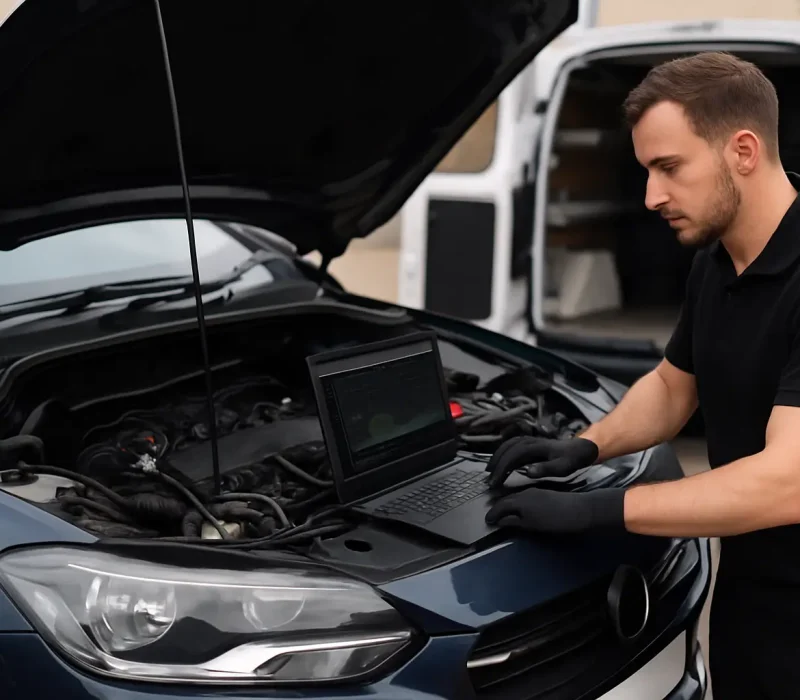
A professional approach starts with the vehicle’s health. That means scanning for fault codes, checking key sensor data, and making sure there are no underlying issues that will mask or undermine the result.
Then it is about choosing sensible targets. For towing, that usually means a strong mid-range torque increase with controlled delivery, while keeping smoke, temperatures and drivetrain limits in mind.
Finally, you want proof the car behaves correctly afterwards. That includes confirming boost control, checking for excessive correction factors, and making sure there are no new fault codes or unwanted behaviours.
If you like the idea of convenience without losing the professional standard, this is exactly the sort of work High REVS Performance provides as a mobile service – custom ECU calibration and diagnostics at your home or workplace, using genuine professional tools. You can book and read more at https://ecurmp.com.
When to remap – and when to fix first
If your vehicle is healthy, serviced, and you simply want more usable pull with the trailer on, a towing-focused remap is often one of the most noticeable upgrades for the money.
If you have recurring DPF faults, heavy carbon build-up symptoms (sluggish response, inconsistent boost), or warning lights that come and go, you will usually get better results by sorting the restriction or fault first. Tuning on top of a breathing problem can feel like it works for a week, then the real issue reappears harder.
A good tuner will tell you that up front. It protects your engine, it protects your wallet, and it keeps the result consistent – which is what you actually want when you are towing something valuable.
A useful way to think about an ecu remap for towing torque is this: you are not asking the vehicle to do something it cannot do, you are asking it to do what it already does – just with less effort. When the calibration is written with that mindset, the drive becomes easier, the engine feels more in control, and towing stops being the part of ownership you dread before every trip.