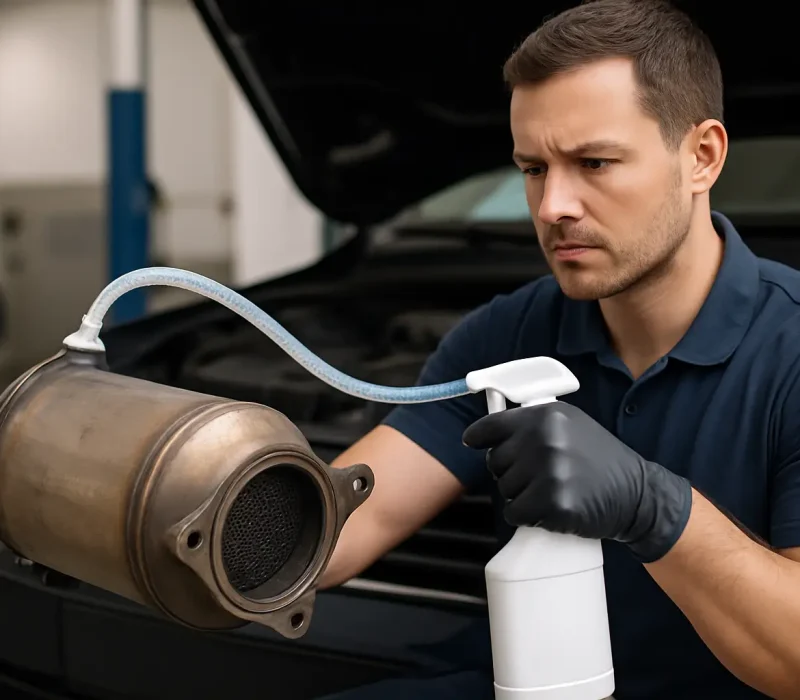


A DPF warning light has a habit of showing up at the worst possible time – right before a long commute, a site visit, or a weekend away. You might still have power, but it feels hesitant. Or you get the dreaded limp mode and suddenly you are nursing the car home. The big question most diesel owners in Tamworth and Staffordshire ask is simple: should you book a dpf chemical cleaning service, or are you about to spend money on something that will just block again?
A chemical clean can be a very effective fix, but only when it is the right fix. The best results come when it is treated as a professional maintenance and fault-resolution procedure, not a miracle cure for every DPF-related problem.
What a DPF actually does – and why it blocks
Your diesel particulate filter sits in the exhaust and traps soot. Under the right driving conditions, the car will periodically raise exhaust temperatures and burn that soot off. That is regeneration.
The issue is that modern diesels spend a lot of their lives doing the opposite of what the DPF needs. Short trips, stop-start traffic, school runs, and low-speed commuting do not generate the sustained heat required to regenerate properly. Soot builds up, the car tries to regen more often, and fuel economy drops. Keep pushing it and you can end up with frequent warning lights, forced regenerations, or a complete blockage.
There is also a second layer that catches people out. Not everything inside the DPF is soot. Ash is the non-burnable residue from oil additives and normal engine wear. Soot can be burned off. Ash generally cannot. So if the DPF is heavily ash-loaded, chemical cleaning may help to a point, but it will not magically return a high-mileage filter to brand-new capacity.
What a dpf chemical cleaning service is designed to fix
A proper dpf chemical cleaning service targets the contamination that is restricting flow through the filter. In plain terms, it is aimed at removing soot and softening or flushing deposits that prevent regeneration and raise exhaust backpressure.
When it is done correctly, the results you are looking for are practical and measurable: the DPF differential pressure comes down, regenerations space out, throttle response feels less laboured, and the car stops constantly trying to “save itself” by dumping extra fuel into the exhaust.
It is also about preventing escalation. Leaving a partially blocked DPF in place often creates a knock-on set of issues. Excessive regeneration attempts can dilute engine oil with diesel, increase EGT stress, and accelerate EGR and intake fouling. So the value is not just clearing a light – it is protecting the rest of the system from being pushed outside normal operating conditions.
Chemical cleaning vs forced regeneration – not the same thing
A forced regen is essentially the car attempting to burn soot out by raising temperatures, usually triggered via diagnostics. It can work when the filter is only moderately loaded and the rest of the system is healthy.
Chemical cleaning is different. It is not relying purely on heat. It is designed to break down and remove deposits, which can make the difference when a forced regen either will not complete or keeps returning because restriction remains too high.
The trade-off is that chemical cleaning should be carried out with the right checks and procedure. If you chemically clean a DPF on a vehicle with an underlying fault – for example an EGR stuck open, a split boost hose, a faulty DPF pressure sensor, or an injector issue creating excessive soot – you may clear it today and be back in the same place next month.
When chemical DPF cleaning is a smart call
It tends to be the right move when the car is showing early-to-mid stage symptoms: intermittent DPF light, reduced MPG, frequent regens, and a noticeable loss of low-down torque. It is also well suited if your driving pattern has changed – perhaps you have moved closer to work or switched to shorter trips – and the DPF has not adapted.
It also makes sense when diagnostics show the DPF is restricted but not physically damaged, and the sensor readings support a “dirty” filter rather than a failed component. That is where a technician-led service, with live data and before-and-after readings, matters.
For small commercial operators and high-mileage drivers, there is another practical benefit: downtime. A mobile service can often deal with the problem on your drive or at your workplace, instead of losing half a day sitting in a waiting room.
When it depends – and when it will not be enough
There are scenarios where chemical cleaning is not the right answer, or it is only part of the job.
If the DPF substrate is cracked or melted, no cleaning method will restore it. If the vehicle has a serious turbo issue pushing oil into the exhaust, the filter can become saturated and cleaning may be short-lived until the root cause is fixed. If the DPF is heavily ash-loaded, you can sometimes improve flow, but you cannot remove years of ash accumulation with a simple on-car clean.
It also depends on how far the fault has progressed. If the car will not regenerate at all because the soot load is beyond safe limits, or the ECU is logging critical codes that inhibit regen, the priority becomes diagnosing and stabilising the system first.
What the process should look like (and what to avoid)
The biggest difference between a professional service and a “quick fix” is process clarity.
A proper job starts with diagnostics. That means reading fault codes and, crucially, checking live data such as DPF differential pressure, calculated soot load, exhaust temperature behaviour, and the plausibility of sensor readings. If a pressure sensor is lying, you can be chasing the wrong problem.
Only then does cleaning make sense. The goal is controlled application of chemicals designed for DPF systems, followed by a procedure that allows loosened deposits to be cleared and the system to return to normal flow.
What to avoid is anything that looks like guessing. Generic additives poured into the fuel tank can have a place for preventative maintenance on a healthy car, but they are not a substitute for a proper clean when the DPF is already restricted. Likewise, repeatedly attempting forced regens without addressing restriction can push temperatures and fuel dilution in the wrong direction.
What results should you expect afterwards?
If chemical cleaning is the right intervention, the most noticeable change is usually drivability. The car pulls more cleanly, especially in the mid-range where a restricted exhaust can make the engine feel strangled. Many drivers also notice the engine is quieter under load and the gearbox is less indecisive because torque delivery is more consistent.
On the practical side, you want to see less frequent regens. If the car was trying to regen every 100 miles, you would expect that to move back towards a healthier interval, depending on your vehicle and usage.
Fuel economy is the other common win, but it depends on how badly the car was compensating. A lightly restricted DPF might not transform MPG overnight. A heavily restricted one that was constantly injecting extra fuel for regen attempts often will.
It is also normal for a technician to advise a short period of suitable driving afterwards. Not because the cleaning “needs motorway miles” to work, but because the system may need a proper temperature cycle to settle back into normal regeneration behaviour.
How to stop the DPF blocking again
A clean DPF is only half the story. If you want it to stay that way, match the fix to your real-world driving.
If your daily usage is short trips, build in one longer run each week where the engine can reach and hold operating temperature. It does not need to be an excuse for a 2-hour blast up the M6, but it does need to be long enough for the car to complete a normal regen when it requests one.
Also take warning signs seriously. Rising oil level, cooling fans running after shut-off, and a sudden drop in MPG can all indicate frequent regeneration. If you catch it early, you tend to avoid the more expensive end of the problem.
Finally, do not ignore the causes of soot in the first place. A DPF is a filter – if the engine is producing excessive soot due to airflow, EGR, boost, or fuelling faults, the filter will do its job until it cannot. Cleaning without correcting the reason for the soot is like changing the bin bag while the lid is stuck open in the rain.
Mobile cleaning and diagnostics – why convenience is not a gimmick
A lot of owners delay sorting DPF issues because the hassle is real: booking time off, arranging lifts, and losing the car for a day. That delay is exactly how a manageable restriction becomes a non-starting vehicle.
A mobile service model removes that friction. If the technician arrives with genuine diagnostic tooling and treats the job as a measured procedure – not a spray-and-pray approach – you can get dealer-level clarity without the dealership timetable.
That is the point of a specialist mobile operation such as High REVS Performance: the DPF clean is not offered as a one-size-fits-all add-on, but as part of a broader capability that includes on-site diagnostics and the kind of process control you want around modern diesel systems.
The real “worth it” test
A dpf chemical cleaning service is worth it when it restores normal exhaust flow and regen behaviour, and when the underlying engine system is healthy enough to keep soot production within the DPF’s working range. It is a waste when it is used to mask faults that will refill the filter with soot, or when the filter is physically compromised.
If you want one guiding principle, use this: treat the DPF warning as a data problem, not just a dashboard problem. The most cost-effective fixes come from measured diagnostics, a procedure that matches the condition of the filter, and driving habits that allow the system to do what it was designed to do. The relief is not just the light going out – it is getting your reliability back without reorganising your week to visit a garage.