

You know the feeling – the diesel that used to pull cleanly now feels strangled, the MPG slips, and the dash light starts hinting at an expensive problem. For a lot of drivers around Tamworth and Staffordshire, that story ends in a garage quote for a DPF replacement. Often, it does not need to.
A mobile chemical DPF clean for a diesel is a practical, on-site way to clear soot and restore flow through the filter without removing it, while keeping your day moving. Done properly, it is not a quick squirt-and-go. It is a measured process built around diagnostics, correct temperatures, and making sure the vehicle can actually complete regeneration again afterwards.
What a DPF is really doing on your diesel
Your diesel particulate filter (DPF) is designed to trap soot so it does not leave the exhaust as black smoke. Over time, the engine management system tries to burn that soot off during a regeneration cycle, using higher exhaust temperatures.
When the car is mainly used for short trips, stop-start commuting, school runs, or low-speed work, the exhaust often does not get hot enough for long enough. Soot load climbs, back pressure rises, and eventually the vehicle starts protecting itself. That is when you see symptoms like limp mode, frequent regen attempts, or warnings that keep returning.
There is also ash. Ash is the non-burnable residue from oil additives and normal wear. Regeneration cannot remove it. Chemical cleaning is mainly aimed at soot restriction and restoring the DPF’s ability to function, but the ash load is part of the long-term picture – and it influences whether a clean is likely to be a strong fix or only a short reprieve.
When “mobile chemical dpf clean diesel” actually makes sense
The best time to chemically clean a DPF is when restriction is building but the system is still fundamentally healthy. If the filter is intact and the issue is soot loading from interrupted regens, a chemical clean can restore exhaust flow and get regeneration back under control.
It also suits drivers who cannot easily lose a day to a workshop. If your vehicle is needed for commuting, site visits, school runs, or local deliveries, having the work carried out at home or at your workplace can remove a lot of friction.
That said, it depends. If the DPF has internal damage, if the vehicle has a hard fault that prevents regen (for example, a failed temperature sensor), or if the oil level is rising due to repeated failed regens and fuel dilution, a chemical clean is not the first step. The right approach begins with finding out what the ECU thinks is happening, not guessing.
Symptoms that point to DPF restriction (not just “a diesel being a diesel”)
A blocked or blocking DPF tends to show up in a few predictable ways. You might notice sluggish acceleration and weaker torque at low revs, because the engine is pushing against exhaust back pressure. You may see the cooling fan running after shutdown more often, because the car has tried to regen. Some vehicles will start doing frequent regeneration attempts, which can push fuel consumption up and make the engine feel harsher.
Dash warnings vary by manufacturer. Some are clear DPF messages, others are generic engine management lights with stored fault codes. If you are getting repeat warnings soon after a forced regen or a long motorway run, that is a sign the underlying restriction or a supporting fault has not been resolved.
How mobile chemical DPF cleaning works in practice
A professional mobile chemical DPF clean is a process, not a product. The goal is to break down and remove soot deposits so the DPF can breathe again, while keeping the system safe.
The job typically starts with diagnostic checks. A technician will read fault codes, look at calculated soot load, and check live data such as differential pressure readings across the DPF. This matters because a pressure sensor fault can mimic a blockage, and a genuine blockage will show a pressure pattern that rises with RPM and load.
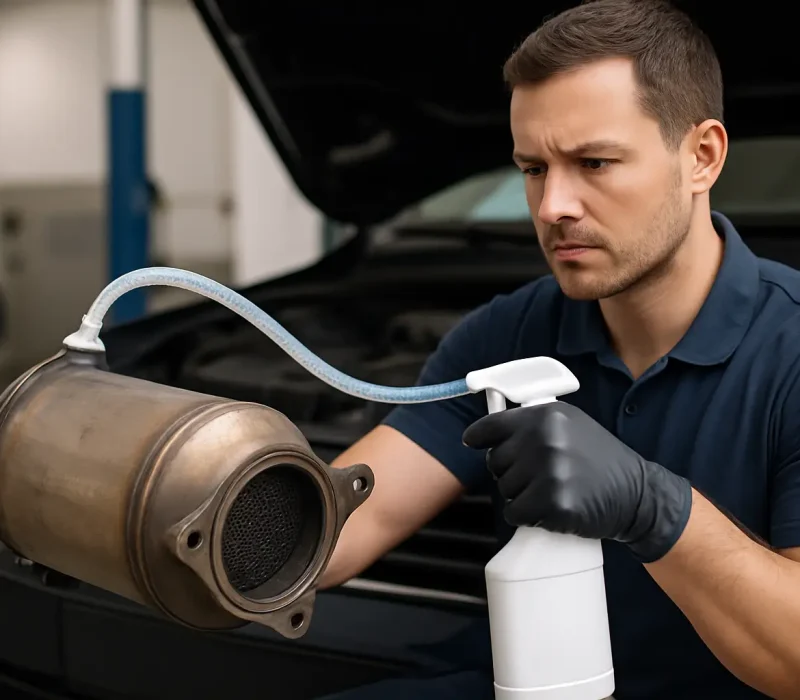
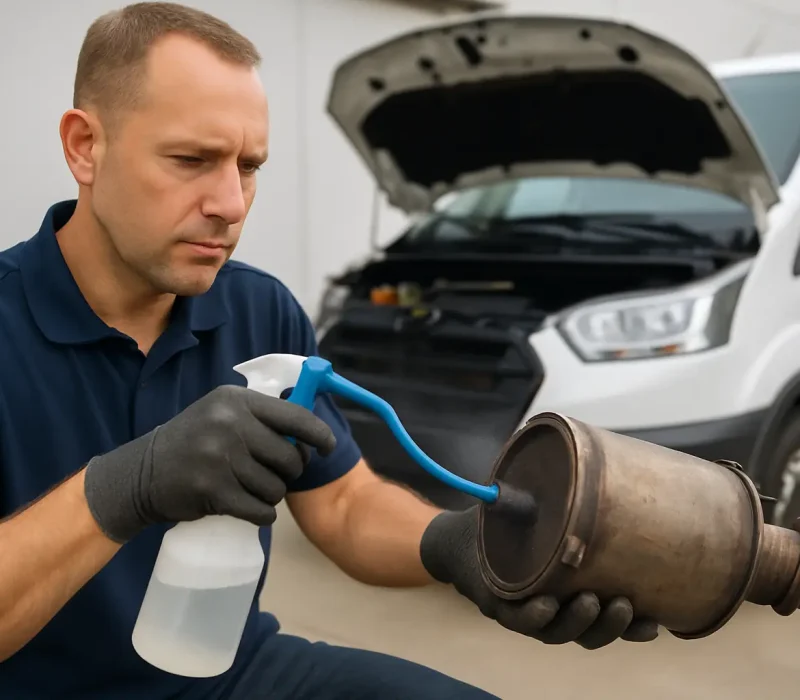
Next comes the cleaning stage. Chemical solution is introduced in a controlled way, usually through dedicated access points in the exhaust system or via sensor ports, depending on the vehicle design. The solution is left to work and then flushed so the loosened deposits can be moved through the system.
Afterwards, the vehicle needs the right conditions to clear out residue and stabilise. That may involve an assisted regeneration or a controlled run where exhaust temperatures are brought up safely. The final step is confirming results – not by feel, but by re-checking differential pressure and ensuring fault codes and regen status make sense.
If you only do the chemical part but skip the diagnostics and verification, you can end up with a car that feels better for a week and then returns to warnings. That is why “mobile” should not mean “rushed”. It should mean the service comes to you with proper tools and proper checks.
What results should you expect, and what you should not
When the DPF is the primary restriction, a successful clean can restore drivability quickly. Drivers often notice stronger low-down pull, smoother throttle response, and fewer regen events. MPG can improve, but it is not a guaranteed number because it depends on your driving pattern and how often the vehicle was trying to regenerate beforehand.
What you should not expect is a chemical clean to fix problems caused by failed components. A stuck-open EGR valve, a boost leak, a faulty injector, or a broken temperature sensor can all cause high soot production or prevent proper regen. Clean the DPF without addressing the cause and the filter will load up again.
You also cannot chemically “repair” a cracked DPF substrate. If the internal ceramic has melted or fractured, cleaning is the wrong tool.
The most common reasons DPFs keep blocking up
Around our area, the pattern is consistent: lots of modern diesels doing the wrong sort of work for their emissions system. Short trips and low-speed use are the big ones, especially in colder months when the vehicle never reaches stable temperature.
The next most common causes are maintenance and supporting faults. Wrong oil specification increases ash. Overdue servicing can lead to poor combustion and more soot. Faulty sensors can stop the ECU from initiating regen at the right time. EGR and intake carbon build-up can restrict airflow and alter fuelling, pushing soot output higher.
This is why a proper DPF service should be paired with a clear view of the engine’s health. Sometimes the best value is not only cleaning the filter, but also resolving the condition that created the blockage.
Mobile convenience is not a gimmick – it changes the economics
DPF issues are expensive partly because they are disruptive. A vehicle off the road can cost more than the repair, especially for small fleets, tradespeople, and anyone who relies on their diesel daily.
A mobile chemical DPF clean reduces downtime because you do not need to arrange lifts, sit in a waiting area, or leave the vehicle for days. You book a slot, the technician comes to you, and the car stays where it is needed. For many owners, that is the difference between fixing the issue promptly and driving on until it becomes a bigger, more costly failure.
How DPF cleaning fits with diagnostics and safe tuning
A lot of DPF trouble starts as a drivability complaint: “It feels flat.” That can be DPF restriction, but it can also be boost control issues, airflow measurement faults, or fuelling corrections. Proper diagnostics stops you spending money in the wrong place.
If you are also considering an ECU remap for economy or drivability, the order matters. You want the mechanical and emissions systems healthy first. A clean, free-flowing exhaust and a DPF that can regenerate properly give a safer baseline for any calibrated changes. Good tuning stays within manufacturer tolerances, works with the engine’s protection strategies, and does not mask faults.
For local drivers who want that kind of joined-up approach – mobile diagnostics, DPF chemical cleaning, and safe custom calibration – High REVS Performance provides on-site appointments across Tamworth and Staffordshire, using genuine professional tools and a process-led mindset: https://ecurmp.com
What to do after a clean so it stays clean
A DPF that has been chemically cleaned will stay healthier if you adjust a few habits. If your driving is mostly short trips, plan a regular longer run where the engine reaches full temperature and stays there. Avoid switching off mid-regen if you can – many vehicles show signs like a higher idle speed or active cooling fans.
Stick to the correct low-ash oil specification for your engine, and keep up with servicing. If you have recurring EGR or intake carbon issues, deal with them early rather than letting them push soot into the exhaust for months.
And if a warning comes back, do not keep forcing motorway runs as a cure-all. Repeated failed regens can dilute oil with fuel and create bigger problems. The sensible move is to read the codes and check the data.
When replacement is the better call
Sometimes a clean is not the cost-effective answer. If the DPF is physically damaged, if ash loading is at end-of-life, or if the vehicle has a history of chronic oil consumption and repeated regens, replacement may be the only durable fix.
A good technician will tell you when that is likely, because the aim is not to sell you a clean at any cost. It is to get the vehicle reliable again with a predictable outcome.
If you are dealing with a DPF warning right now, the best next step is simple: treat it like a data problem before it becomes a parts problem. Once you know the soot load, differential pressure behaviour, and any supporting faults, you can choose the fix with confidence – and keep your diesel doing the job you actually bought it for.