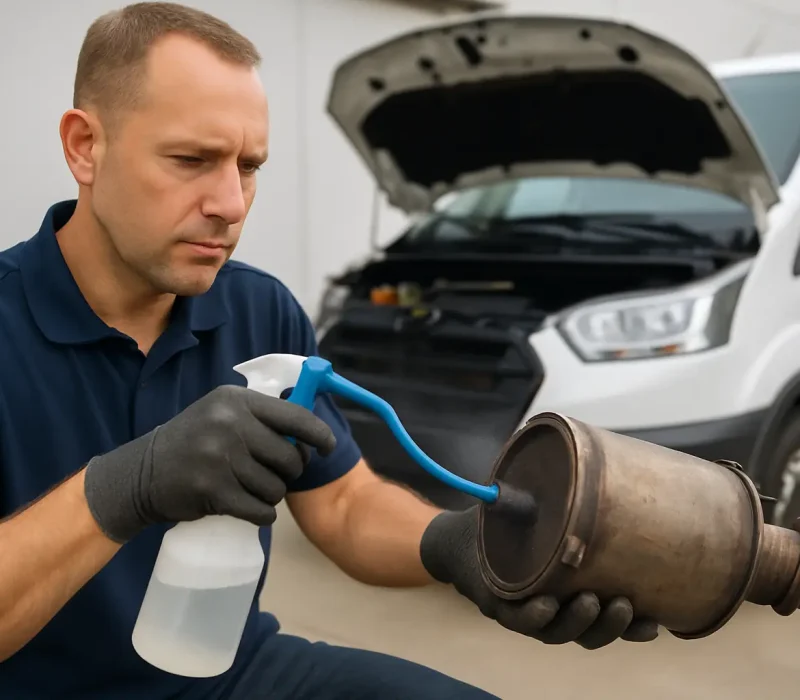


That moment when the DPF light comes on is rarely random. Most drivers notice it after a week of short trips, a spell of stop-start commuting, or a towing run that pushed exhaust temperatures in all the wrong ways. The car feels flat, fuel economy drops, the cooling fan seems to run on, and before long you are worrying about limp mode or an expensive replacement.
The good news is that many blocked filters can be recovered. The bad news is that some can’t – and trying the wrong “quick fix” can make the job harder (and pricier). Below is a practical, safety-first way to think about how to unblock a DPF filter, when to try a regeneration, when a chemical clean is appropriate, and when you need proper diagnostics before you do anything else.
What a DPF blockage actually is
A diesel particulate filter (DPF) traps soot in the exhaust. Under the right conditions the engine management system raises exhaust temperature and burns that soot into a much smaller amount of ash. That burn-off is regeneration.
A blockage usually starts as a soot-loading problem, not a “filter is full forever” problem. Soot is meant to come and go. Ash, on the other hand, is the non-combustible residue left over time (from oil additives and normal combustion) and it gradually reduces the filter’s capacity. If you have mostly soot, the right regen strategy and a clean can restore flow. If you have high ash load, the filter may need off-car cleaning or replacement.
The other complication is that the DPF system is not just the filter. It relies on accurate readings from differential pressure sensors, temperature sensors, and it depends on the engine being healthy enough to burn cleanly. A DPF that blocks repeatedly is often a symptom of another fault.
Signs your DPF is blocking (and what they mean)
A warning light on its own does not tell you whether the car is asking for a simple regen or whether it has already limited regeneration to protect itself. Pay attention to the behaviour around the light.
If you have a DPF light with otherwise normal power, it can be an early request for a motorway-style drive to complete a passive or active regen. If you have reduced power, poor throttle response, increased fuel consumption, or the engine management light alongside it, that is more likely to be a higher soot load, a failed regen attempt, or a sensor or engine issue that is preventing regen.
Frequent cooling fan operation after shutdown, a stronger diesel smell, or a slightly higher idle can also show an active regen is trying to run. Interrupting regens repeatedly is one of the quickest routes to a blocked DPF on modern diesels.
How to unblock a DPF filter: start with the safest win
Before you spend money on parts or pour anything into the tank, you want to establish whether the vehicle is even capable of regenerating.
Step 1: Check the basics that stop regeneration
DPF regeneration is often disabled by faults that are not “DPF faults”. Low fuel level, certain glow plug faults, EGR-related errors, boost leaks, or temperature sensor issues can stop the ECU from commanding a regen. If the car is in limp mode, it is telling you the ECU has already decided conditions are unsafe.
If you have access to a proper diagnostic scanner, look for soot loading values, DPF differential pressure readings at idle and at 2,000 rpm, and any stored codes relating to exhaust temperature sensors, DPF pressure sensors, EGR, turbo control, injectors, or glow system. Generic code readers are better than nothing, but they often miss the live data you need to make a confident decision.
Step 2: Attempt a correct road regeneration (only if suitable)
If there are no underlying faults and the soot load is within a recoverable range, a controlled motorway run can clear it.
Pick a route where you can maintain steady speed and engine load. Aim for a warm engine and sustained driving rather than bursts of acceleration. As a general rule, 20 to 30 minutes at consistent road speed with the engine sitting in the mid-rev range is more effective than a quick “Italian tune-up” with hard pulls.
You are trying to maintain exhaust temperature, not prove a point. If the DPF light clears and drivability returns, you have likely removed the excess soot. If it does not clear, do not keep repeating the same run for days. Multiple failed regens can dilute engine oil with diesel and increase the risk of turbo and engine wear.
Step 3: Use a DPF fuel-borne additive only in the right scenario
Tank additives can help the soot burn at a lower temperature, which can support a vehicle that is struggling to complete regens due to driving style. They are not a magic unblocker for a heavily loaded DPF, and they won’t remove ash. Think of them as assistance, not a cure.
If you use one, do it as part of a proper regen drive with a warm engine. Avoid doubling up products or treating it like a weekly routine. Overuse can increase ash accumulation over time, which reduces the filter’s long-term capacity.
When a chemical DPF clean is the right tool
If soot load is high, the car is requesting regeneration frequently, or it has failed regens, an on-vehicle chemical clean can be a sensible next step. This is not the same as pouring a bottle into the tank. A professional chemical clean is applied directly into the DPF (usually via a pressure sensor port) and is designed to break down soot and restore flow so the ECU can complete a regen again.
Done correctly, chemical cleaning can:
- reduce differential pressure and help the turbo spool normally
- restore fuel economy and reduce forced-regeneration frequency
- prevent an unnecessary DPF replacement when the filter is still structurally sound
It depends on the type of blockage. If the filter substrate is damaged, melted (often from repeated failed regens or injector issues), or packed with ash, chemical cleaning may improve it temporarily or not at all. That is why a proper reading of pressures and soot or ash estimations matters.
Why forced regeneration is not a first step
A forced regen with diagnostics equipment can be effective, but it is not risk-free. The process pushes exhaust temperatures very high. If the DPF is too restricted, temperatures can spike and damage the substrate. If the engine has an injector fault, boost issue, or incorrect sensor readings, you can end up with an uncontrolled situation that creates more problems than you started with.
Forced regeneration makes sense when diagnostics show it is safe, the soot load is within limits, and the system is otherwise healthy. It should be treated as a controlled procedure, not a last-minute panic button.
If the DPF keeps blocking, look upstream
Repeated DPF blockage is almost always telling you something about how the engine is running or how the vehicle is used.
Short, low-speed journeys are the obvious cause, but they are not the only one. A sticking EGR valve can increase soot production. A boost leak or split intercooler hose can cause poor combustion and higher particulate output. Worn injectors can over-fuel and create excessive soot. A faulty DPF pressure sensor can report incorrect loading and trigger unnecessary regens or warnings.
There is also the ash factor. If the vehicle is higher mileage and has lived on the wrong oil (non-low-SAPS), the ash content can climb quickly. No regen will remove that. At that point, you are looking at off-car cleaning or replacement, and it is better to know sooner than keep spending on partial fixes.
What not to do (because it gets expensive)
There are plenty of internet fixes that feel satisfying and cost very little, right up until the DPF cracks or the turbo fails.
Avoid drilling the DPF, removing internals, or fitting blanking plates. Aside from the legal and MOT implications, the ECU strategies and sensor feedback rely on a working system. You also risk higher exhaust temperatures and long-term engine issues.
Be cautious with aggressive “DPF flush” methods that involve large volumes of fluid without understanding where it will go. Liquids can pool, carry debris into sensors, and in worst cases contribute to thermal shock if a regen is triggered.
And do not ignore rising oil level. If repeated regen attempts are dumping diesel into the sump, driving on diluted oil can damage bearings and turbochargers quickly.
The convenient route: diagnose, clean, and fix the cause
If you want a reliable outcome, the most time-efficient approach is usually: confirm the fault with live data, restore flow with the correct cleaning method, then address the reason it blocked in the first place. That might be as simple as changing driving habits to allow regular regens, or it might involve fixing an EGR issue, replacing a pressure sensor, or correcting a boost leak.
For drivers around Tamworth and Staffordshire who want this handled without a garage visit, High REVS Performance operates as a fully mobile service with professional diagnostics and diesel DPF chemical cleaning on-site, so you can get dealer-level process without losing a day to drop-offs and collections.
A sensible driving pattern that keeps DPFs healthy
Once the light is out and the car is back to normal, prevention is mostly about giving the system what it needs. If your vehicle spends most of its time on short runs, build in a weekly longer drive where the engine gets fully warm and stays there. Avoid switching off mid-regen if you can help it. Keep up with the correct low-ash oil spec and service intervals, because oil choice has a direct impact on long-term ash loading.
If you tow, do lots of low-speed site work, or run a small fleet on tight routes, plan your maintenance around reality rather than hope. A DPF is not fragile, but it is not forgiving when the operating conditions never allow it to do its job.
A helpful closing thought: treat the DPF light like a maintenance request, not a dare. The earlier you respond with the right checks, the more likely the fix is a clean and a proper regen – not a replacement bill.