

You know the feeling: the diesel used to pull cleanly in the mid-range, then one week it feels like it is towing a caravan it has not actually got. The throttle needs more pedal, the gear changes come earlier, and the fuel gauge drops faster than it should. Most drivers assume it is “just a tired engine” or bad fuel. Very often, it is carbon.
Modern diesels are brilliant at torque and economy, but the way they achieve low emissions can also create the perfect conditions for soot and oily vapour to bake onto the parts that control airflow. If you are searching for carbon build up symptoms diesel engines show, you are already asking the right question – because the earlier you catch it, the easier and cheaper it is to put right.
Carbon build up symptoms diesel owners notice first
Carbon build-up is not one single fault. It is a gradual restriction of airflow and movement in components that need to stay clean to meter air and exhaust properly. That is why the symptoms usually start subtle, then stack up.
A common early sign is lazy response at low revs. You press the pedal and it moves, but it does not feel crisp. On a manual, you may find yourself dropping a gear more often for hills that used to be fine in a higher gear. On an automatic, it may hunt between gears because the engine is not producing the expected torque.
Fuel economy often drifts down without any obvious change in your route. Carbon restricts airflow, so the ECU requests more fuel to meet the torque demand. You might also notice more frequent DPF regenerations, or the cooling fans running after a drive more often than you remember. That can be the system working harder to manage soot load.
Rough idle and vibration can appear when deposits affect the EGR valve, intake swirl flaps (where fitted), or the throttle body on some diesels. If those parts cannot control airflow smoothly, the engine can feel uneven at idle and during gentle cruising.
Smoke can change too, but it depends. Some vehicles show a bit more black smoke under load, especially if the intake is restricted and combustion quality drops. Others barely smoke at all because the ECU compensates, meaning the first “symptom” is simply a car that feels slower.
Warning lights, limp mode, and why they are often late-stage symptoms
Drivers often only take action when a light appears, but warning lights are usually the end of the story rather than the beginning. Carbon build-up contributes to fault codes in a few ways: EGR flow faults, intake air plausibility issues, boost deviation faults, and DPF-related codes when soot load becomes hard to manage.
Limp mode tends to happen when requested boost and actual boost do not match for long enough, or when the ECU sees repeated emissions system faults. By that point, the vehicle is protecting itself. It does not automatically mean a turbo is failing, but it does mean you should stop guessing and get proper diagnostics.
Why carbon build-up happens in modern diesels
Diesels naturally produce soot, and modern emissions systems recirculate and trap that soot to reduce what leaves the tailpipe. Add in crankcase ventilation vapour (oily mist) and you get a sticky mixture that clings to intake surfaces.
Short trips make it worse. If the engine does not reach stable operating temperature for long enough, moisture and vapour do not burn off, and EGR duty cycles can be high at low load. That combination is a recipe for deposits.
Driving style matters, but not in a simplistic “you need to drive it hard” way. Regular low-load, low-RPM driving can allow more build-up, while a healthy mix of steady motorway runs can help keep temperatures and airflow in a better range. That said, once deposits are established, a few fast runs rarely remove them. It may improve how it feels temporarily, but it is not a true clean.
Where the carbon actually builds up (and what each area causes)
Carbon build-up is usually most problematic in the EGR system and intake tract. When the EGR valve and cooler accumulate deposits, the valve can stick or respond slowly. That can cause hesitation, uneven running, and increased soot output which then feeds the DPF.
Inside the inlet manifold, deposits narrow the runners and disrupt airflow. On engines with swirl flaps, carbon can restrict flap movement or cause them to stick. That can reduce low-speed torque and create a flat spot.
The DPF is slightly different. It is designed to fill with soot and then regenerate, but it cannot do that properly if soot production is excessive, regeneration is interrupted, or ash load is high from long-term use. Carbon-related airflow and EGR issues can push the DPF over the edge, turning an underlying build-up problem into a very obvious drivability problem.
The quick checks that separate carbon symptoms from other faults
Carbon symptoms overlap with boost leaks, faulty MAF/MAP sensors, sticking turbo vanes, injector issues, and even simple service items like a clogged air filter. The goal is not to self-diagnose perfectly – it is to avoid throwing parts at the car.
If the vehicle is sluggish but there is no whistle, no obvious hissing, and no split hoses, carbon remains a strong candidate, especially on higher-mileage diesels or those used for town driving.
If the car has an intermittent limp mode that resets after cycling the ignition, that often points to an out-of-range reading rather than a hard failure. Deposits causing EGR flow issues or boost control deviations can behave exactly like that.
If fuel economy worsens and the DPF regeneration frequency increases, do not assume the DPF “has gone”. Very often the DPF is reacting to upstream soot production. Address the cause and the DPF load behaviour can improve.
A proper diagnostic scan is where this becomes clear. Live data can show EGR commanded versus actual position, airflow readings, boost request versus actual, and DPF differential pressure trends. That is the difference between a targeted fix and a guess.
What you can do about it (and what actually works)
If the symptoms are mild, your first step is to make sure the basics are right: correct oil specification, fresh air filter, and no overdue servicing. The wrong oil can increase vapour and ash loading, and a restricted air filter can mimic the feel of an intake restriction.
Driving changes can help prevent build-up getting worse, but they are not a clean in themselves. A weekly longer run at stable speed can support proper operating temperature and reduce interrupted regenerations. If your usage is mostly short journeys, be realistic: the vehicle is working against its own design constraints.
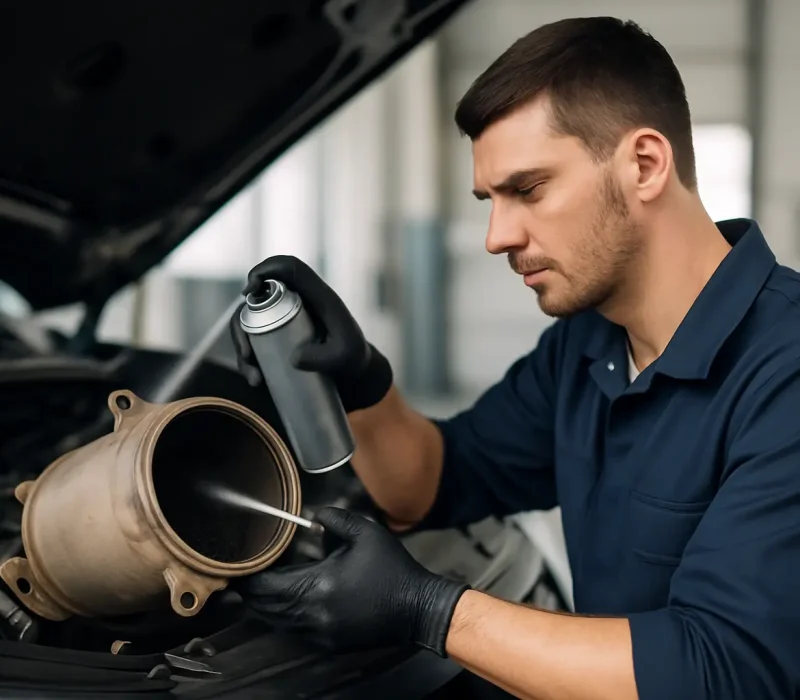
Chemical and physical cleaning is where you see measurable change when carbon is established. Targeted engine carbon cleaning focuses on restoring airflow through the intake path and addressing the deposits that create poor response and uneven running. DPF chemical cleaning is a separate process aimed at restoring flow through the filter by reducing soot load and improving regeneration behaviour. The right approach depends on what the diagnostics say and which symptom is dominant.
Remapping is sometimes part of the solution, but it depends on the condition of the car and the goal. A safe, custom calibration can improve drivability and torque delivery, and an economy-focused map can reduce the “work” the engine does for the same road speed. But a remap should not be used to mask a mechanical restriction. Clean and diagnose first, then tune if it suits your priorities.
When to stop driving and book it in
If you have a flashing warning light, persistent limp mode, or the car is struggling to complete regenerations, do not keep pushing it. Continued driving with high exhaust backpressure can increase turbo stress and raise running temperatures, and repeated failed regens can lead to excessive dilution in the oil on some vehicles.
The other moment to act is when the symptoms are still mild. A diesel that is only “slightly flat” is typically easier to restore than one that is already forcing limp mode and throwing multiple codes.
For drivers around Tamworth and Staffordshire who want dealer-level diagnostics without the garage hassle, a mobile specialist can test the car on your drive or at your workplace and then recommend the right fix based on real data. High REVS Performance is one option locally, and they operate fully mobile with diagnostics, diesel DPF chemical cleaning and engine carbon cleaning alongside safe, custom-written remaps within manufacturer tolerances – details are on https://ecurmp.com.
The trade-offs people rarely mention
Carbon management is not one-size-fits-all because it is tied to how you use the vehicle. If you do lots of short trips, even a perfectly maintained diesel can struggle compared to a car that does regular motorway miles. In that case, the realistic target is “controlled and monitored” rather than “it will never happen again”.
Also, cleaning can reveal other issues. When airflow is restored, weak sensors, marginal injectors, or a tired turbo actuator may show their hand because the engine is no longer compensating around restrictions. That is not a downside of cleaning – it is the car returning to a state where faults can be diagnosed accurately.
Finally, be wary of parts roulette. Replacing an EGR valve or DPF without understanding why it failed can lead to the same issue returning. Diagnostics plus a plan is almost always cheaper than repeating the same repair cycle.
A helpful way to think about carbon build-up is this: it is not a sudden event, it is a gradual loss of airflow and control. If you pay attention to the early feel of the car – throttle response, torque, economy, and regen behaviour – you can keep your diesel driving the way it should, without waiting for a warning light to force the issue.