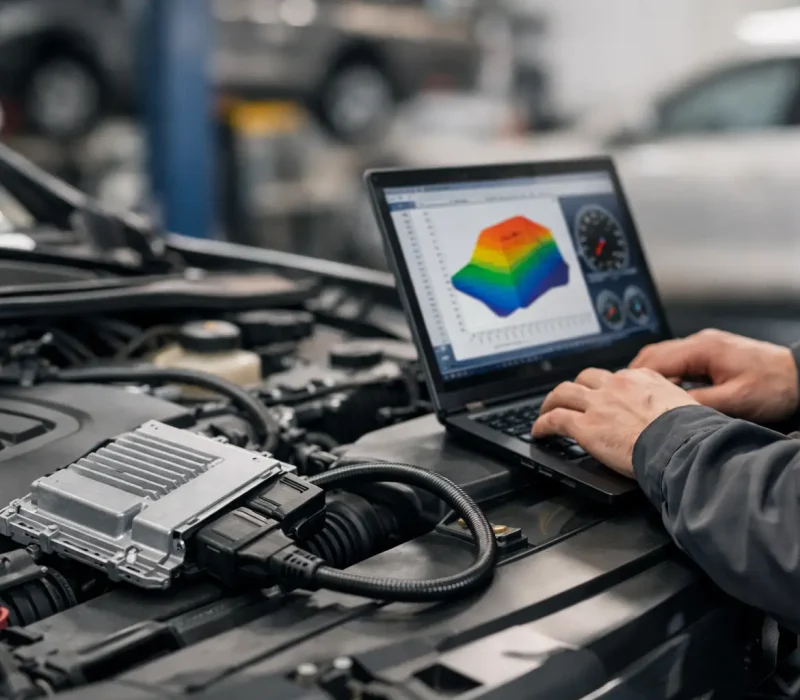



High REVS Performance brings mobile ECU remapping and diagnostics to drivers across Tamworth and Staffordshire, so the ECU remap versus tuning box question often comes up on the driveway before any work begins. Both can make a vehicle feel stronger, but they achieve it in very different ways. One is a custom calibration written around your vehicle; the other is an add-on device that alters signals between sensors and the engine control unit.
For a driver who wants sharper overtaking response, stronger towing torque or better motorway economy without losing a day at a garage, the difference matters. The right choice is not simply the cheapest route to more power. It is the one that suits the vehicle, its condition and what you genuinely need it to do.
ECU remap versus tuning box: the key difference
An ECU remap involves reading the software from the vehicle’s engine control unit, adjusting the calibration within safe manufacturer tolerances, then writing the revised file back to the ECU. At High REVS Performance, this is carried out at your home or workplace with genuine professional tuning equipment. The calibration can be tailored towards Eco, Balanced or Stage 1 Power results rather than applying the same outcome to every driver.
A tuning box is an external module fitted into the wiring loom, usually around a fuel-pressure sensor or boost-pressure sensor. It changes the information reaching the ECU, encouraging the system to deliver more fuel or alter boost response. Many boxes are marketed as quick to fit and easy to remove, which is their main appeal.
The practical distinction is control. A proper remap can adjust several relevant maps together, such as torque delivery, boost targets, fuelling and throttle response, while retaining the vehicle’s built-in protection strategies. A basic tuning box generally influences a smaller number of sensor signals. It can produce a noticeable gain, but it has less scope to refine how that gain is delivered.
Why a custom Stage 1 remap usually feels better
A good Stage 1 remap is not just about chasing the biggest headline figure. On the road, the useful improvement is normally earlier, smoother torque and a more responsive pedal. That can make joining a fast A-road, carrying tools in a van or towing a caravan feel less laboured without constantly changing down a gear.
Because the software is written for the specific ECU and vehicle, torque can be managed more progressively. This matters on modern diesel and turbo petrol engines, where an abrupt surge can make the car unpleasant to drive and place unnecessary strain on the clutch, gearbox and drivetrain.
A tuning box may create extra pull, particularly in the mid-range, but the delivery can be less precise. Cheaper units can also be a poor match for the engine’s existing calibration and condition. The result may be uneven acceleration, excess smoke on a diesel, fault codes or reduced confidence when the vehicle is loaded.
For drivers focused on running costs rather than outright performance, an Eco or Balanced remap gives a more relevant route. Extra low- and mid-range torque means the engine may need less throttle and fewer downshifts in normal use. Actual MPG gains depend on driving style, journey type and vehicle condition, but a calibration designed around usable torque is more purposeful than simply increasing a sensor reading.
A typical local example
A common job is a 2.0 TDI Volkswagen Transporter used by a self-employed tradesperson around Tamworth, often carrying tools during the week and covering motorway miles at weekends. The owner may be considering a plug-in box because it looks simple and can be fitted quickly.
Before recommending a Stage 1 remap, the sensible first step is on-site diagnostics. If the van has stored boost-control faults, a tired airflow reading or a DPF loading issue, adding power first is the wrong order of work. Once the underlying issue is addressed, a custom Stage 1 calibration can give stronger pull in the gears that matter, making the van easier to drive with a load while maintaining sensible operating limits.
That is a better outcome than fitting a box to mask a vehicle that was already struggling.
The case for a tuning box
Tuning boxes are not automatically poor products. A quality, vehicle-specific box can suit someone who wants a temporary, reversible change and understands its limitations. For example, a customer with a leased vehicle may prefer not to alter the ECU software, although they should still check their lease terms and insurance requirements before fitting any performance device.
Installation can be quicker, and the box can normally be removed. However, removal does not change the fact that the vehicle has been operated with altered engine signals, and it should never be used as a reason to overlook servicing, warning lights or known mechanical faults.
The market is also full of very cheap generic boxes with ambitious claims. These are the units that deserve the most caution. A low purchase price can be quickly outweighed by poor drivability, warning lights or problems that require diagnostic time to identify. If a device claims to suit a huge range of unrelated engines with one setting, it is unlikely to offer the precision of a custom calibration.
Safety starts before the tune
Whether you choose a remap or are already running a tuning box, vehicle health comes first. Modern engines are closely monitored, and a warning light is useful information, not something to tune around. High soot loading, boost leaks, injector concerns, sensor faults and carbon buildup can all affect how an engine performs and how it responds to additional torque.
This is particularly relevant for diesel owners seeing intermittent DPF warnings, reduced power or frequent regeneration attempts. A remap does not replace DPF chemical cleaning when the filter is restricted. In fact, asking for more performance from a diesel with a blocked DPF can worsen the situation.
On-site diagnostics identify stored and live faults before a calibration is considered. Where a DPF is genuinely loaded, mobile DPF chemical cleaning may restore exhaust flow and help prevent the cost of premature DPF replacement. Once the engine is running correctly, the choice between an Eco, Balanced or Stage 1 Power remap becomes a much more informed decision.
Convenience should not mean compromise
The attraction of a tuning box is often convenience: plug it in, gain power and carry on. Mobile remapping offers a more thorough form of convenience. There is no need to arrange a lift, sit in a waiting room or take time off for a garage visit. The technician comes to your home or workplace with the correct diagnostic and tuning equipment.
That also gives you the opportunity to discuss how you use the vehicle. A high-mileage commuter has different priorities from a driver towing regularly, and both differ from an enthusiast who wants a more engaging weekend car. A custom-written remap can reflect those priorities instead of forcing every vehicle into a single preset.
Professional process also matters if the vehicle needs checking before work starts. Reading fault codes, assessing relevant live data and explaining any issues clearly protects the customer as much as it protects the engine. It is a more transparent approach than promising a fixed power figure before anyone has looked at the vehicle.
Which option makes sense for you?
Choose a tuning box only if reversibility is your overriding concern, the product is genuinely vehicle-specific and the vehicle is mechanically sound. It may deliver a worthwhile change, but be realistic about its narrower control over the engine calibration.
For most owners who want dependable, well-managed gains, a custom ECU remap is the stronger long-term option. It offers scope to improve the areas that affect everyday driving – torque, throttle response, overtaking ability and, where appropriate, fuel economy. A Stage 1 Power remap is ideal for drivers wanting a more responsive vehicle, while Eco and Balanced options suit those looking to reduce fuel spend without making the car feel over-tuned.
If your vehicle has a DPF warning, limp mode, poor economy or inconsistent power, book a mobile diagnostic appointment with High REVS Performance before choosing either route. If it is healthy and ready for more from the engine, book your mobile ECU remap in Tamworth or Staffordshire and get a calibration written for the way you actually drive.