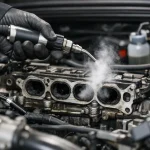



A diesel warning light rarely arrives on its own. Often, it turns up with poor throttle response, reduced power, extra smoke, a cooling fan running when it should not, or a van that suddenly drops into limp mode on a busy workday. That is why diesel fault codes matter – they are not just numbers on a screen, but clues to what the engine management system has seen and why the vehicle is no longer performing as it should.
The key is reading those clues properly. A fault code does not always mean a part has failed outright. In many cases, it is reporting a condition outside expected limits. That could be a blocked DPF, a sticking EGR valve, a split boost hose, a tired sensor, poor combustion caused by carbon build-up, or even a battery voltage issue creating misleading symptoms. Good diagnostics are about context, not guesswork.
What diesel fault codes actually tell you
Modern diesel engines rely on a network of sensors, actuators and control strategies to manage fuelling, boost pressure, emissions and regeneration cycles. When something falls outside the range programmed into the ECU, it stores a fault code. Some codes are confirmed faults, some are pending, and some are historic. That difference matters.
If you plug in a basic reader and see one code, it is tempting to assume you have found the problem. Sometimes you have. More often, you have found the starting point. For example, a DPF efficiency code might be caused by repeated interrupted regenerations, but it can also be triggered by an EGR issue, an exhaust pressure sensor problem, faulty temperature readings or driving patterns that never allow the system to complete its clean-out cycle.
That is why experienced technicians do more than read codes. They check live data, compare requested values against actual values, look at soot load and differential pressure, and test whether the fault is electrical, mechanical or operational. It saves replacing good parts and helps avoid the all-too-common cycle of clearing the light only for it to return days later.
Common diesel fault codes and the problems behind them
Some diesel fault codes appear more often than others because modern diesels tend to suffer from a familiar group of issues. DPF-related codes are among the most common, particularly on vehicles doing short journeys, stop-start commuting or low-speed town driving. When regeneration cannot complete properly, soot loading rises, exhaust backpressure increases and performance starts to suffer.
EGR faults are another regular visitor. A sticking or carboned-up EGR valve can affect airflow, combustion quality and emissions readings. The driver may notice hesitation, rougher running or excess smoke, but the ECU only sees values that no longer match what it expects. The code points you towards the affected system, not always the exact failed component.
Boost control faults are also common on diesel cars and vans. These may involve underboost or overboost conditions caused by split hoses, vacuum issues, sticking turbo vanes, actuator problems or sensor inaccuracies. A vehicle used for towing or carrying weight may expose these faults more quickly because the engine is working harder under load.
Then there are sensor and electrical codes. Mass airflow sensors, manifold pressure sensors, exhaust gas temperature sensors and NOx sensors all play a role in diesel management. A poor connection, contaminated sensor or wiring fault can trigger a code that mimics a much larger issue. This is where proper testing matters. Replacing sensors on assumption gets expensive very quickly.
Why one fault can trigger several codes
A diesel engine system is interconnected. If airflow is wrong, fuelling can be affected. If combustion quality drops, soot output rises. If soot rises, the DPF has to work harder. If the DPF becomes restricted, turbo behaviour and exhaust temperatures can shift. The result is that one underlying problem can create a chain of stored faults.
This is why a code list should be prioritised, not treated as a shopping list of parts. The earliest or most critical fault often leads the diagnosis. Once that is resolved, other codes may disappear because they were secondary reactions rather than separate failures.
A good example is a vehicle with EGR flow faults, DPF pressure faults and boost deviation. It is possible all three systems have issues, but it is equally possible that one airflow problem has upset the rest. Without live testing and a structured approach, it is easy to spend money in the wrong place.
Diesel fault codes and limp mode
Limp mode is the ECU protecting the engine or emissions system when readings move too far outside safe limits. It can feel dramatic to the driver because power is heavily reduced, revs may be limited and the vehicle becomes frustrating to use. For anyone commuting, towing or running a small business vehicle, that can turn a minor warning into a serious inconvenience.
Not every fault code causes limp mode, but recurring DPF restriction, serious boost errors, fuel pressure problems and some sensor failures often do. Clearing the code without fixing the cause may temporarily remove the symptom, yet the ECU will usually detect the issue again as soon as the conditions return.
If your diesel has gone into limp mode once, that is the point to stop delaying diagnosis. Continued use can turn a manageable issue into a more expensive repair, especially where DPF loading, exhaust temperature or turbo operation are involved.
What to check before assuming the worst
There are practical checks worth making before jumping to the costliest conclusion. First, look at how the vehicle is being used. Repeated short runs are hard on DPF-equipped diesels. If the engine rarely reaches full operating temperature or rarely sees sustained motorway speeds, regeneration can struggle.
Second, pay attention to the symptoms around the code. Is fuel economy down? Has the throttle response become flat? Is there visible smoke, a whistle from the boost system, hard starting or an uneven idle? Those clues help separate an airflow problem from a fuelling issue or an emissions-system fault.
Third, consider maintenance history. An overdue air filter, poor-quality oil, missed servicing or a long-standing intake contamination issue can all contribute. Carbon build-up is especially common on modern diesels and can affect airflow enough to trigger recurring warning lights and poor performance.
That said, some faults genuinely do come down to part failure. Sensors age, valves stick, pipes split and electrical components fail. The point is not to avoid repairs. It is to make sure the repair matches the evidence.
Why proper diagnostics save money
When diesel fault codes are diagnosed properly, the result is usually faster resolution, fewer unnecessary parts and a clearer plan of action. That matters whether you use the vehicle for family mileage, site visits, deliveries or towing. Downtime costs money, and guesswork tends to add more of it.
Dealer-level diagnostics are useful because they allow deeper access to manufacturer-specific data, guided tests and regeneration information. Combined with experience, that makes it easier to tell the difference between a blocked DPF that can be addressed, a sensor problem giving false readings, and a mechanical issue that needs repair before any cleaning or recalibration work is considered.
For diesel owners in Tamworth and Staffordshire, mobile diagnostics also remove some of the friction. If the vehicle is down on power or stuck in limp mode, getting it checked at home or work can be far more practical than arranging recovery or losing half a day in a waiting area.
When codes relate to performance and economy
Not every customer looking into diesel fault codes is dealing with a breakdown-level problem. Sometimes the vehicle still drives, but not as well as it used to. It feels lazy, uses more fuel, struggles under load or no longer responds cleanly in the mid-range. In those cases, stored codes can reveal underlying issues that are limiting both reliability and efficiency.
This is especially relevant before any ECU tuning work. A proper remap should only be carried out on a mechanically healthy vehicle with no unresolved faults affecting airflow, fuelling, boost or emissions control. Safe gains come from a sound baseline. If warning codes are present, they need addressing first so the calibration is built on accurate data and normal operating behaviour.
That is one reason experienced specialists put diagnostics ahead of promises. Whether the goal is restored MPG, smoother torque delivery or stronger Stage 1 performance, the vehicle has to be right first.
Don’t treat the warning light as the repair
A dashboard light can be cleared in minutes. Fixing the reason it appeared takes more care. With diesel systems, the difference matters because many faults are symptoms of a pattern – driving style, carbon accumulation, restricted exhaust flow, weak sensor signals or an issue building gradually over time.
If your vehicle has logged diesel fault codes, the best move is to use them as a starting point, not a verdict. Read the data properly, match it to the symptoms, and deal with the cause before it becomes a bigger interruption. A diesel that starts cleanly, pulls strongly and regenerates properly is usually giving clear signals long before it gives up completely. Listening early is cheaper than reacting late.