


A diesel that suddenly feels flat, will not rev freely or struggles to hold speed is not just frustrating – it can be protecting itself. So, can a clogged DPF cause limp mode? Yes. A heavily restricted diesel particulate filter can trigger limp mode when the engine control unit detects exhaust back-pressure or a failed regeneration condition that could damage the engine, turbocharger or emissions system.
Limp mode is not a diagnosis in itself. It is the vehicle’s response to a fault it considers serious enough to limit power and torque. A blocked DPF is one common cause, particularly on diesels used mainly for short trips, stop-start commuting or local deliveries. However, the correct repair depends on confirming why the DPF became blocked in the first place.
How a clogged DPF causes limp mode
The DPF sits in the exhaust system and captures soot produced during diesel combustion. Over time, the vehicle burns that soot away through a process called regeneration. During an active regeneration, exhaust temperatures are raised so the soot can be converted into a small amount of ash.
When regeneration completes regularly, the filter can continue doing its job with little input from the driver. The problem starts when regeneration is interrupted repeatedly, cannot reach the required temperature, or another engine fault creates excessive soot. The filter fills, exhaust flow becomes restricted and the pressure difference across the DPF rises.
The ECU monitors this through pressure sensors and calculated soot-loading values. Once the readings pass a safe threshold, it may store fault codes, illuminate the engine management or DPF warning light, and reduce available boost, fuelling and torque. That reduction is limp mode.
The limitation is deliberate. Continuing to demand full power through a severely restricted exhaust can put excessive strain on the turbocharger and raise exhaust gas temperatures. It may also leave fuel diluted in the engine oil if repeated regeneration attempts have failed.
Symptoms that point to DPF-related limp mode
A DPF fault does not always put a vehicle into limp mode straight away. Early signs are often subtle: poorer fuel economy, a cooling fan running after the engine is switched off, a slightly higher idle speed, or a noticeable change in exhaust smell during regeneration.
As the restriction worsens, drivers may notice reduced acceleration, poor response when joining a dual carriageway, difficulty pulling under load, and a vehicle that feels unwilling to rev beyond a certain point. Towing drivers and light commercial operators often notice the loss of torque first, especially on inclines.
A DPF warning light, engine management light or glow-plug warning light may appear depending on the make and model. Some vehicles will display a message instructing the driver to continue driving to clean the filter. That instruction can be valid at an early stage, but it is not a universal fix. If limp mode has already appeared, forcing a long drive without checking the fault can make matters worse.
Why a motorway run does not always solve it
A regular, sustained run can help a healthy diesel complete passive or active regeneration. It is most useful when the DPF loading is still moderate and no underlying fault is stopping regeneration.
But a motorway journey cannot remove ash. Ash is the non-combustible residue left behind after soot has been burned off, largely from engine oil additives and normal engine wear. It gradually accumulates over the life of the filter. Nor can a long drive repair a failed pressure sensor, faulty temperature sensor, boost leak, injector issue, EGR fault or thermostat that prevents the engine reaching proper operating temperature.
There is also a practical risk. If the DPF is heavily loaded, the ECU may have already disabled normal regeneration to protect the system. Continuing to drive at high load with severe restriction can increase temperatures and back-pressure. The sensible next step is professional diagnostics, not repeated hard driving in the hope the warning will disappear.
A blocked DPF is often the result, not the root cause
Short journeys are a common contributor because the engine and exhaust may not get hot enough for regeneration to finish. That does not mean every short-trip diesel will block its DPF, or that every blocked filter is caused by town driving.
The technician should assess the whole picture: live DPF pressure readings, calculated soot and ash levels, regeneration history, exhaust temperature sensor data, engine temperature, fault codes and oil condition. This shows whether the filter itself is restricted and whether the engine is creating more soot than it should.
Common underlying causes include an EGR valve that is sticking, a boost-control fault, worn or leaking injectors, intake carbon build-up, a split hose, a faulty DPF differential-pressure sensor, or a thermostat that keeps the engine too cool. On some vehicles, a low fuel level or repeated interrupted journeys can also prevent active regeneration.
Replacing or cleaning the filter without addressing the cause can provide only temporary relief. The warning light may return because the conditions that blocked the DPF have never changed.
What happens during a proper diagnosis
Dealer-level diagnostic equipment can read the stored fault codes, but the most useful information comes from live data. A technician can compare pressure readings at idle and under controlled engine speed, check temperature sensor behaviour and establish whether the ECU is requesting or inhibiting regeneration.
This avoids guesswork. A pressure reading that looks high may be caused by a genuinely blocked filter, but it can also be caused by a sensor or pipe fault. Equally, a low reading does not automatically prove the DPF is healthy if the sensor is inaccurate.
At High REVS Performance, mobile diagnostics can be carried out at your home or workplace across Tamworth and the surrounding Staffordshire area. That is particularly useful when limp mode makes a journey to a garage inconvenient or when a work vehicle needs downtime kept to a minimum.
Cleaning, forced regeneration or replacement?
The right route depends on the restriction level, the condition of the filter and the cause of the fault. An early soot-loading issue may be resolved by correcting the underlying problem and allowing a controlled regeneration. A workshop-style forced regeneration can be appropriate in some cases, but only after confirming that the DPF, sensors and engine are safe for the process.
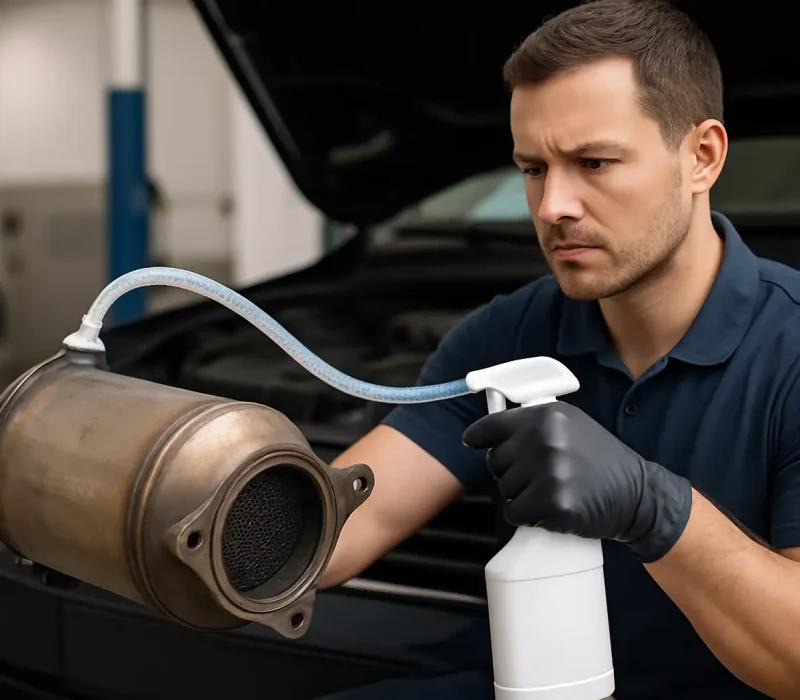
For a filter with meaningful soot and residue build-up, professional DPF chemical cleaning can restore exhaust flow and reduce back-pressure without immediately moving to an expensive replacement. The cleaning process should be paired with diagnostic checks before and after treatment, so there is evidence that the filter has responded.
Replacement is sometimes unavoidable. A cracked, melted or physically damaged DPF cannot be chemically repaired. Neither can a filter with excessive ash loading or one that has repeatedly failed due to an unresolved mechanical fault. Removing the DPF or having it coded out is not a legitimate repair for a road vehicle and can create MOT, insurance and legal problems.
What to do when your diesel enters limp mode
If the warning appears but the vehicle remains safe to drive, avoid hard acceleration, towing heavy loads or trying to force a regeneration through repeated high-speed runs. Check the oil level as well. A level above the maximum mark can indicate fuel dilution from failed regeneration attempts and needs prompt attention.
If there is excessive smoke, a red warning light, unusual turbo noise, a severe loss of power or the engine is overheating, stop driving and arrange recovery. Those symptoms can indicate a fault beyond a routine DPF restriction.
For less severe cases, book a diagnostic assessment before spending money on additives, sensors or a replacement filter. The cheapest apparent option can become expensive if it masks the warning without restoring correct regeneration.
A DPF warning is best treated early, while cleaning and targeted repair remain realistic options. Accurate diagnosis can restore the torque, fuel economy and dependable day-to-day driving your diesel was designed to deliver – without the unnecessary cost and inconvenience of replacing parts on assumption.