


A warning light that disappears before the appointment, a car that only loses power on the motorway, or an engine that occasionally cranks longer than normal can be frustrating. So, can diagnostics find intermittent faults? Often, yes – but a quick code read alone is not always enough. Finding a fault that comes and goes depends on the quality of the diagnostic equipment, the technician’s test process, and the information available about when the problem happens.
Modern vehicles record far more than a dashboard warning light suggests. Even when a fault is not active at the time of testing, the engine ECU and other control modules may retain a fault code, freeze-frame data, counter, adaptation value or communication error that points towards the cause. The key is interpreting that evidence properly rather than replacing parts based on a single code.
Why intermittent faults are harder to diagnose
A permanent fault is usually straightforward to confirm. A failed sensor with an open circuit, for example, may trigger an immediate warning light and a consistent fault code every time the vehicle is scanned. An intermittent fault behaves differently. It may occur only when the engine is hot, after heavy rain, under hard acceleration, during a DPF regeneration, or when a wiring loom moves with engine vibration.
That means the vehicle can arrive running perfectly. The fault may be stored as pending, historic or sporadic, or it may have cleared after several successful drive cycles. Some issues will not store a useful code at all, particularly if the signal drops out for only a fraction of a second or remains within the ECU’s expected limits.
Intermittent problems are common on vehicles with high mileage, frequent short journeys or demanding use. Commuters may notice a warning after stop-start traffic. Diesel owners may experience reduced power only during regeneration conditions. Towing drivers can find that a boost, fuel-pressure or transmission issue appears only under sustained load. The pattern matters as much as the code.
What professional diagnostics can find
Dealer-level diagnostic equipment can communicate with far more than the engine ECU. It can scan the vehicle’s control modules, read manufacturer-specific faults, view live data and carry out actuator tests where the vehicle supports them. This gives a technician a better chance of locating the system involved, even if the original symptom is not currently present.
A proper diagnostic session may reveal evidence such as:
- Historic and pending diagnostic trouble codes, including the mileage and conditions recorded when the code set
- Freeze-frame information, such as coolant temperature, engine speed, vehicle speed and load at the moment of failure
- Live values from sensors including boost pressure, fuel rail pressure, airflow, exhaust temperature and DPF pressure
- Misfire counters, regeneration history, injector correction figures and module communication errors
- Battery-voltage drops, charging faults or network issues that can affect several systems at once
These readings need context. A fault code for low boost does not automatically mean the turbocharger has failed. It could relate to a split hose, sticking actuator, vacuum leak, wiring issue, blocked DPF, inaccurate pressure sensor or a control condition triggered elsewhere. Likewise, a DPF warning does not always mean the DPF itself needs replacing. The cause may be failed temperature sensing, an additive-system issue, unsuitable driving conditions or excessive soot caused by another engine fault.
Can diagnostics find intermittent faults without a warning light?
Yes, they can – but there are limits. If the ECU has logged an event, saved abnormal data, or shows live readings that do not behave correctly, a technician may be able to identify the issue without the warning light being on. This is especially useful for occasional limp mode, inconsistent throttle response, poor fuel economy and repeated DPF-related warnings.
However, no diagnostic tool can recreate evidence that is not present. If a connection only fails after an hour of driving in wet weather, a scan performed on a dry driveway may not prove the cause immediately. In those cases, diagnostics should guide the next test rather than force a guess.
The best approach may involve a road test with live data recording, visual inspection of wiring and hoses, voltage-drop checks, smoke testing for intake leaks, or testing when the engine is cold and then fully hot. For an electrical fault, carefully moving a suspected loom or connector while monitoring the signal can expose an internal break. For a fuel or air issue, comparing requested values with actual readings under load can be far more useful than checking values at idle.
The details you provide can save diagnostic time
Drivers often say, “It just comes and goes.” That is understandable, but a few specific details can make the difference between a broad inspection and a focused diagnosis. Before booking, make a note of what happens and under what conditions.
Does the issue occur on cold starts, after 20 minutes of driving, or only when the engine is hot? Is it linked to rain, speed bumps, motorway speeds, towing or strong acceleration? Does cycling the ignition restore power? Are there warning messages, smoke, unusual fan activity, rough running or a change in fuel consumption?
If it is safe to do so, a photo of the dashboard message before it clears is useful. Avoid clearing fault codes with a basic reader before the vehicle is inspected. Clearing codes can remove freeze-frame data and reset information that helps establish the fault. It may also make an intermittent problem harder to prove.
Common intermittent fault patterns
Some patterns appear regularly, although every vehicle still needs to be tested on its own evidence. A weak battery or charging issue can cause seemingly unrelated dashboard warnings, particularly in colder weather. Low voltage can affect module communication, stop-start operation and sensor reference signals.
Wiring and connector faults are another common cause. Heat, vibration, water ingress and oil contamination can affect terminals or damage wiring internally. A connector may look acceptable from the outside while a pin has poor contact under vibration.
Air and boost leaks can create occasional loss of power, whooshing noises and low-boost codes. Hoses may open up only when pressure rises. EGR valves, boost-control actuators and intake components can also stick intermittently, particularly where carbon deposits have built up.
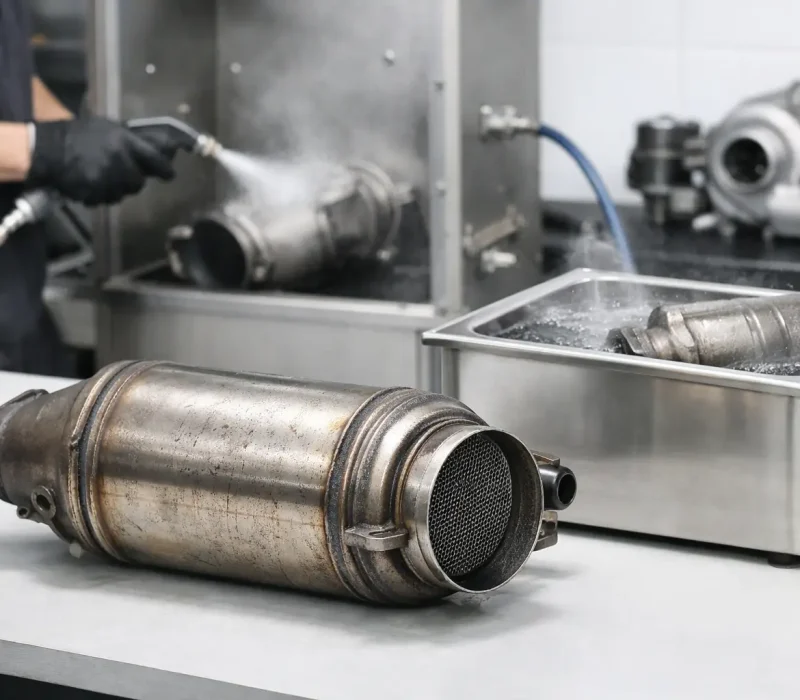
On diesel vehicles, DPF differential-pressure readings and exhaust-temperature data deserve careful attention. A pressure sensor may report an implausible value only when hot, while repeated interrupted regenerations can lead to soot loading and eventual limp mode. The right repair is based on measured soot and ash values, pressure readings, regeneration status and the underlying reason the filter loaded up – not simply deleting a code.
Why replacing parts first can become expensive
Intermittent faults are where guesswork costs the most. It is tempting to fit a new sensor because a code mentions that sensor, but the code may report the result of a wiring problem, poor earth, air leak or mechanical issue. A new part can appear to help for a few days simply because connectors have been disturbed, adaptations have been reset or the driving conditions have changed.
A structured diagnostic process reduces this risk. It starts by checking the full vehicle scan and stored information, then confirming power supplies, grounds and relevant live data. Physical checks follow where needed, and a repair should be verified under the conditions that originally caused the issue. If a fault cannot be duplicated on the first visit, honest advice and a targeted next step are better than selling unnecessary parts.
When a mobile diagnostic visit makes sense
Mobile diagnostics are particularly useful when the vehicle is unreliable, in limp mode, difficult to get to a garage or only shows the symptom on a familiar route. Testing can be carried out at home or at work, saving time and inconvenience while still using professional-grade equipment and a methodical process.
For drivers across Tamworth and Staffordshire, High REVS Performance can assess stored faults, live data and the wider condition of the vehicle on site. Where a DPF, carbon buildup or engine-management issue is involved, the focus should always be on confirming the cause before deciding whether cleaning, repair or further investigation is the sensible route.
If your fault is intermittent, keep a short record of when it happens and resist the urge to clear the evidence. That small amount of information gives diagnostics the best chance of turning an occasional problem into a clear, reliable repair.