

A diesel remap should make a vehicle easier and more rewarding to drive, not turn every journey into a reliability gamble. Safe diesel remap limits are not defined by the largest dyno figure advertised online. They are set by the condition of the engine, the capacity of its supporting components and the way the vehicle is used every day.
For a motorway commuter, a towing vehicle or a working van, usable torque in the right part of the rev range matters more than a headline power number. A properly written calibration can improve throttle response, strengthen mid-range pull and, when driven sensibly, support better fuel economy. The key is leaving appropriate safety margins rather than forcing hardware beyond what it was designed to handle.
What Safe Diesel Remap Limits Actually Mean
A remap adjusts the ECU software that controls fuelling, boost pressure, torque delivery, injection timing and other engine strategies. Modern diesel engines are electronically managed in great detail, so changing one request can affect temperatures, drivetrain load and emissions-control behaviour elsewhere.
A safe remap works within the capability of the specific vehicle. It does not simply raise every limiter or load a generic file intended for a different engine variant. Manufacturer tolerances provide useful headroom in many turbo-diesel engines, but that headroom is not unlimited and it is not identical across every car or van.
The sensible limit is therefore the point where the improvement remains repeatable in real conditions: a cold morning commute, a loaded run up the A-road, motorway cruising, stop-start traffic and occasional towing. If a calibration only feels safe during one short full-throttle pull, it has not been developed with everyday ownership in mind.
The Components That Set the Limit
Turbocharger and charge-air system
Turbochargers are often the first consideration. More boost can produce more air and allow more fuel to be burned efficiently, but excessive boost raises turbo speed and intake-air temperature. It can also expose weak boost hoses, tired intercoolers and small leaks that were not obvious at standard power.
A safe calibration targets a boost level the turbo can maintain efficiently, rather than chasing pressure for its own sake. On a healthy engine, this gives strong, consistent torque without placing unnecessary stress on the turbocharger or filling the intake system with excessive heat.
Exhaust gas temperature and fuelling
Diesel power comes from a controlled balance of air, fuel and timing. Adding fuel without enough air, or using aggressive timing changes, can drive exhaust gas temperatures too high. Sustained high temperature is particularly hard on turbochargers, exhaust valves, manifolds and the DPF.
This is why a good remap is more than a torque-limit increase. Fuelling needs to be calibrated through the rev range, with attention paid to smoke control, air mass and how the engine behaves under prolonged load. A car used mainly for short local trips has different demands from a vehicle that regularly tows a caravan or trailer.
Clutch, gearbox and drivetrain
Torque is what makes a remapped diesel feel so effective, especially from low revs. It is also what tests the clutch, dual-mass flywheel, gearbox and driveshafts. A clutch that is already near the end of its life may begin to slip after a remap, even if the increase would be perfectly acceptable on a well-maintained example.
Manual gearboxes and automatic transmissions each have their own torque limits and control strategies. On some vehicles, a conservative torque curve is the right choice because it protects the transmission while still delivering a noticeable improvement in overtaking response. Delivering torque progressively can be safer and more pleasant than a sudden low-rpm surge.
DPF, EGR and general engine condition
A remap cannot repair a blocked DPF, sticking EGR valve, split intake hose, worn injector or existing fault code. In fact, increasing demand on an engine with an unresolved issue can make the underlying problem more obvious and more expensive.
Before tuning, the vehicle should be assessed properly. Diagnostic checks can identify stored fault codes, boost-control problems, sensor readings outside expectation and signs that the DPF is struggling to regenerate. Where carbon build-up or DPF loading is affecting airflow and economy, resolving that first gives the remap a sound foundation.
No safe road-going remap should remove or defeat emissions-control systems. Aside from legal and MOT implications, those systems form part of how the vehicle manages soot, exhaust temperatures and normal operation. The right approach is to diagnose and repair faults, not hide them in software.
Why the Same Engine Can Have Different Limits
Two vehicles with the same badge and engine code can require different calibrations. One may have covered 35,000 motorway miles with regular servicing; the other may have done 120,000 short journeys with a tired clutch and a history of DPF warnings. Their safe starting point is not the same.
Specification also matters. Factory power outputs can differ because of injectors, turbocharger part numbers, intercooler size, gearbox calibration and emissions equipment. This is one reason off-the-shelf files are a poor substitute for a custom-written remap. A file should be matched to the ECU read, vehicle specification and the owner’s intended use.
At High REVS Performance, this means treating the pre-remap health check as part of the service, not an inconvenience before the interesting work begins. A mobile appointment at home or work can include professional diagnostics, so obvious concerns are identified before changes are made.
Choosing the Right Remap Rather Than the Biggest One
Most drivers do not need the most aggressive available calibration. They need the vehicle to do its job better.
An Eco remap can suit high-mileage drivers who want smoother torque delivery and the opportunity to improve MPG on regular longer journeys. Savings still depend on driving style, load, route and vehicle condition, but reducing the need for heavy throttle can make a meaningful difference.
A Balanced remap is often the practical choice for everyday cars and vans. It combines stronger mid-range performance with sensible fuel-efficiency potential, making joining faster traffic, overtaking and carrying passengers or equipment less effortful.
A Stage 1 Power remap is best for owners who want a more engaging drive and noticeably stronger acceleration while retaining standard hardware. Even then, Stage 1 is not a fixed number. The safe result may be more conservative on a high-mileage vehicle, a towing vehicle or one with a gearbox close to its rated torque capacity.
The best calibration is the one you can use confidently every day. If the vehicle needs to start reliably on Monday, carry tools on Wednesday and tow at the weekend, that requirement should shape the tune.
Warning Signs That a Remap Should Wait
A responsible tuner should be willing to say not yet. Common warning signs include an engine-management light, limp-mode episodes, DPF regeneration issues, excessive smoke, boost leaks, rough idle, clutch slip or poor starting. Unusual turbo noise and unexplained oil consumption also need investigation before performance is increased.
Some faults are straightforward to resolve, while others call for a deeper mechanical inspection. Either way, repairing the cause first protects your investment. It also prevents disappointment when a remap exposes a problem that was already present but less noticeable at standard power.
Servicing matters after tuning too. Use the correct oil specification, keep to sensible service intervals and allow the engine to warm through before demanding full load. After hard driving or towing, a short period of gentle running helps stabilise temperatures rather than switching off immediately after sustained boost.
A Safer Way to Get More From Your Diesel
There is no honest universal figure for how much power or torque every diesel can safely gain. Anyone promising one without checking the vehicle is simplifying a technical decision that depends on hardware, condition and use.
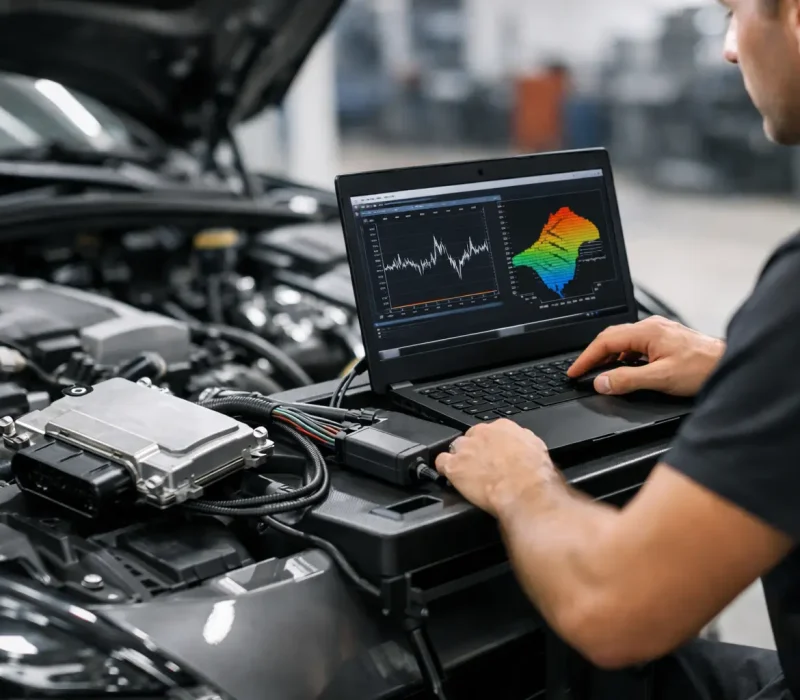
A well-developed remap should feel controlled rather than dramatic for the wrong reasons. Throttle response should be cleaner, torque should arrive predictably, and the vehicle should remain comfortable to drive in traffic as well as capable on an open road. That is the value of using genuine professional tools, clear diagnostics and a calibration written with proper margins.
If your diesel is healthy, serviced and suited to the intended increase, a conservative custom remap can deliver more of the performance and economy you already expect from it – without sacrificing the reliability you rely on.
Check what Stage 1 does for your car
Enter your reg and see the power and torque gains for your exact car. Mobile remapping across Tamworth and the surrounding areas.
Check my car →Prefer to talk? Call 07803 102280