

A warning light appearing on the way to work does not automatically mean an expensive repair. Equally, clearing a fault code and hoping it stays away is rarely a fix. A proper guide to vehicle fault finding starts with the symptoms you can feel, the conditions in which they occur and the diagnostic evidence stored by the vehicle.
Modern cars and vans rely on dozens of control modules, sensors and actuators. When one reading falls outside its expected range, the ECU may store a code, reduce engine power or switch on a warning light. The code is a useful starting point, but it is not a parts-shopping list. Professional fault finding is the process of establishing why the system has reported a problem before recommending a repair.
Start With the Symptom, Not the Warning Light
Before connecting diagnostic equipment, take note of what the vehicle is doing. A diesel that loses power only under heavy acceleration needs a different line of investigation from one that struggles to start when cold. Details that appear minor can save considerable time and prevent unnecessary replacement parts.
Consider when the fault occurs. Does the engine management light return immediately after being cleared, only on motorway journeys, or after short town driving? Is there smoke from the exhaust, a rough idle, poor fuel economy, hesitation, reduced turbo response or a change in engine noise? For commercial vehicles and high-mileage drivers, record whether the issue appears with a load, while towing or during repeated stop-start use.
Also check the basics before assuming an electronic failure. Low engine oil, incorrect coolant level, a weak battery, damaged intake hoses and overdue servicing can all create symptoms or fault codes that point elsewhere. A battery that drops voltage during cranking, for example, can cause multiple unrelated electrical warnings.
A Guide to Vehicle Fault Finding: The Right Order
Reliable diagnosis follows a method. Skipping straight to the most likely-looking component may seem quicker, but it often leads to wasted money and an unresolved fault.
Read Codes and Live Data Together
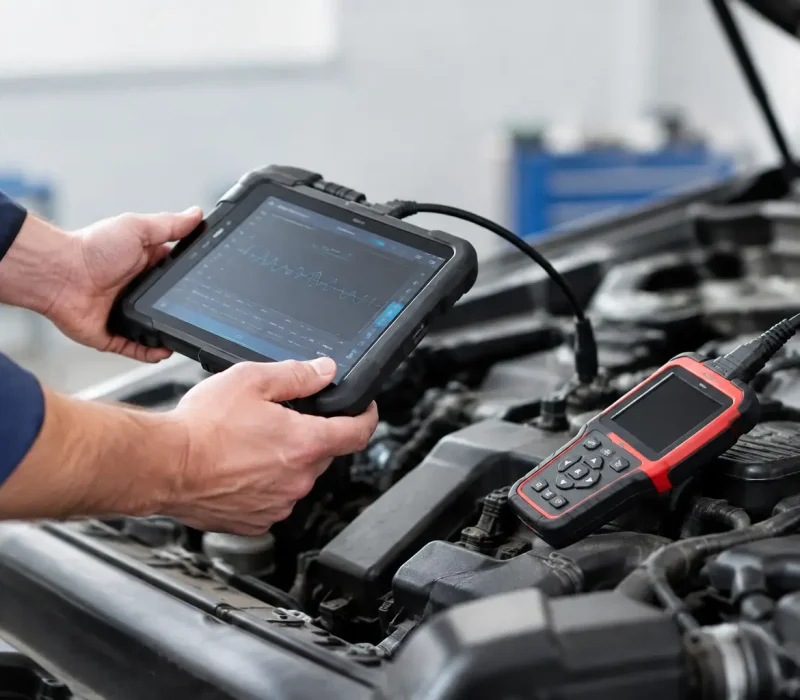
Diagnostic tools communicate with the vehicle’s ECU and other modules to retrieve stored, pending and historic fault codes. Stored codes show a fault severe or consistent enough for the ECU to record. Pending codes may indicate an intermittent issue that has not yet triggered a warning light. Historic codes can be useful context, although they may relate to a problem already repaired.
The code wording must be interpreted alongside live data. A code relating to low boost pressure, for instance, does not prove that the turbocharger has failed. The cause could be a split boost pipe, sticking actuator, vacuum issue, blocked DPF, sensor reading, intake restriction or an exhaust leak. Live data allows the technician to compare requested boost with actual boost, assess airflow readings and see how the system behaves under the conditions that bring on the fault.
This is why dealer-level diagnostic capability matters. It provides more than a basic code number, giving access to manufacturer-specific information, system tests and real-time values where the vehicle supports them.
Check the Simple Physical Causes
Electronic systems cannot compensate for every mechanical issue. Once diagnostic evidence suggests a system, physical checks help narrow the cause. A visual inspection may reveal chafed wiring, oil contamination in a connector, a loose earth point, a cracked vacuum line or a pipe that has come adrift.
On diesel engines, faults involving airflow, EGR operation, boost control and DPF performance are often connected. Carbon deposits can restrict intake components and affect airflow. A DPF carrying excessive soot or ash can increase exhaust back pressure, contribute to limp mode and prevent the engine from delivering normal power. Replacing a sensor without checking the condition of the system it monitors can be an expensive false economy.
Test, Repair, Then Verify
A credible repair should be followed by verification. After the underlying cause has been addressed, codes can be cleared and the vehicle retested. Depending on the fault, this may involve a road test, a controlled regeneration procedure, repeated live-data checks or allowing the ECU to complete its readiness monitors.
If a warning returns, the next step is not to keep clearing it. The repeated code, freeze-frame information and new live data can reveal what was missed or whether there are two connected faults. Intermittent faults are particularly dependent on this methodical approach.
Common Symptoms and What They Can Mean
Symptoms overlap, so no single sign confirms a diagnosis. Still, recognising common patterns helps you decide how urgently to act.
Engine Management Light and Limp Mode
An engine management light can relate to emissions, fueling, ignition, boost, sensors or electrical circuits. If the vehicle enters limp mode, the ECU has detected a condition that could affect emissions, performance or component protection. You may notice restricted acceleration, limited revs or reduced turbo assistance.
Avoid demanding driving until the cause is known. Continuing to tow, accelerate hard or repeatedly force the engine under load can worsen some faults. It does not always mean you need recovery, but flashing warnings, severe loss of power, overheating, unusual noises or heavy smoke should be treated as urgent.
Poor MPG, Sluggishness and Uneven Power
Falling fuel economy can be caused by driving pattern, tyre pressures and seasonal conditions, but it can also indicate an engine operating outside its intended efficiency range. Restricted airflow, incorrect temperature readings, boost leaks, DPF loading and EGR-related issues can all affect how efficiently a diesel or petrol engine runs.
For drivers who complete mainly short trips, a diesel DPF may not reach the temperatures required to regenerate consistently. A longer uninterrupted run can assist only when the vehicle is otherwise healthy and the DPF load is within a safe range. It will not correct a failed pressure sensor, an injector issue or an underlying fault preventing regeneration.
DPF Warnings
A DPF warning deserves early attention. Left too long, a manageable soot-loading issue can develop into persistent limp mode, failed regeneration attempts or the need for costly component replacement. Proper assessment should establish the soot and ash values, differential pressure readings, regeneration history and any faults affecting the system.
Chemical DPF cleaning can be an effective maintenance solution where the filter is structurally sound and the cause of the blockage has been addressed. It is not a substitute for diagnosis. If an EGR, boost, sensor or fueling fault is creating excessive soot, cleaning alone may offer only temporary relief.
Rough Starting, Misfires and Smoke
A rough cold start may point to glow plug, injector, air leak, compression, battery or sensor concerns on a diesel. Petrol misfires can involve plugs, coils, injectors, air leaks or fuel delivery. Smoke colour offers clues but not certainty: black smoke often suggests excess fuel or insufficient air, while blue smoke can indicate oil burning. White smoke has several possible causes and should be assessed in context.
Do not ignore a persistent misfire. Unburnt fuel can damage catalytic converters, while fueling faults may affect the DPF on diesel vehicles.
When a Remap Is Relevant – and When It Is Not
A safe, custom ECU remap can improve torque delivery, throttle response and, in the right use case, fuel economy. Eco, Balanced and Stage 1 Power calibrations each suit different drivers, whether the priority is motorway mileage, everyday flexibility or stronger overtaking and towing performance.
However, remapping should never be used to hide a fault. A vehicle with active engine, boost, DPF, fueling or transmission concerns should be diagnosed and repaired first. Increasing demand on an unhealthy system can make the original issue more obvious and may create further problems. A responsible calibration works within manufacturer tolerances and is written for a vehicle that is mechanically sound.
When Professional Mobile Diagnostics Make Sense
Basic code readers are useful for identifying that a warning exists, but they have limits. They may not access every module, explain manufacturer-specific faults, provide reliable live data or support system tests. They also cannot inspect a split hose, verify wiring integrity or judge whether a DPF reading is plausible.
Professional mobile diagnostics are particularly useful when the vehicle is still driveable but inconvenient to take to a garage, when a warning has returned after a repair, or when a work vehicle needs downtime kept to a minimum. For drivers in Tamworth and across Staffordshire, an on-site assessment at home or work can provide a clearer route to repair without losing a day to workshop arrangements.
Bring as much history as possible to the appointment: recent repairs, service records, when the fault began and whether any warning lights were cleared. That information, combined with professional tools and a structured inspection, gives the diagnosis the best chance of being right first time.
The most useful outcome is not simply a code erased from the dashboard. It is knowing what caused the fault, what repair is justified and what can be done now to protect reliability, performance and running costs.