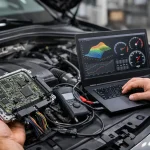



If you are weighing up a remap and wondering, does remap affect MOT emissions, the honest answer is yes – but not always in the way people assume. A well-written, vehicle-specific remap does not automatically mean your car will fail its MOT. Problems usually come from poor calibration, deleted emissions systems, existing engine faults, or a diesel that was already struggling with soot, smoke or DPF issues before any tuning was carried out.
That distinction matters. Many drivers hear the word remap and picture excessive smoke, warning lights and a car that will never pass a test again. In reality, the MOT is looking at what comes out of the exhaust and whether required emissions equipment is present and working as it should. A safe remap within manufacturer tolerances can still pass perfectly well. A badly modified car, or one with emissions hardware removed or masked in software, is a different story.
Does remap affect MOT emissions on petrol and diesel cars?
It can, because a remap changes the way the engine is controlled. Fuel delivery, boost pressure, ignition timing, torque limits and throttle behaviour can all be adjusted. Those changes influence combustion, and combustion affects emissions.
On a petrol car, the MOT emissions test focuses on gases such as carbon monoxide, hydrocarbons and lambda values. If the remap keeps fuelling and ignition properly balanced, and the catalytic converter is healthy, there is no reason a remapped petrol should automatically fail. Where trouble starts is when a calibration pushes fuelling too far, ignores existing faults, or the car already has issues with sensors, misfires or catalyst efficiency.
On a diesel, the visible issue people worry about most is smoke. Older diesels are smoke tested rather than tested in the same way as petrol cars. If a remap causes excessive fuelling under load, or if the turbo, injectors, EGR or DPF are not working correctly, smoke levels can rise. Again, the remap may be a factor, but it is often only part of the picture.
What actually causes a remapped car to fail an MOT?
The remap itself is rarely the whole reason. Usually, failure comes down to one of three things.
First, the calibration may be poor. Generic files written without regard for the exact software version, engine condition or hardware limits can overfuel the engine. On a diesel that often means more soot. On a petrol, it can mean poor catalyst performance or unstable emissions readings.
Second, emissions systems may have been tampered with. If a DPF has been removed, hollowed out or software-switched off, that is a major red flag. The same applies to catalytic converters that are missing or obviously modified. An MOT tester is not just checking the printout – they are also checking that required components are present.
Third, the vehicle may already have an underlying fault. A remap cannot fix a worn injector, a sticking EGR valve, a split boost hose, a blocked DPF or a tired mass airflow sensor. In some cases, it can make those weaknesses more noticeable because the engine is being asked to deliver more torque or run more efficiently.
The big issue for diesels – smoke, DPFs and EGR systems
For diesel owners, this is where most of the concern sits. A diesel remap that is written properly should control fuelling cleanly and keep smoke within sensible limits. In many cases, improved torque delivery means the vehicle drives more efficiently and can feel cleaner in normal use. But that only holds true if the DPF and related systems are healthy.
A diesel particulate filter is there to catch soot. If it is partially blocked, forced to regenerate too often, or unable to regenerate properly because of driving style or another fault, emissions can become a problem regardless of the remap. A tuned diesel with a struggling DPF is a common combination behind smoke complaints, warning lights and MOT anxiety.
The EGR system matters too. Its job is to help reduce nitrogen oxide emissions by recirculating a portion of exhaust gases. When it sticks, clogs with carbon or behaves erratically, combustion quality suffers. That can lead to rough running, poor economy and smoke issues that people wrongly blame on tuning.
This is why sensible remapping should always sit alongside vehicle health checks and diagnostics. If the car already has a DPF issue, boosting performance without addressing it first is asking for trouble.
Does remap affect MOT emissions if the tune is safe?
Yes, in the technical sense, because it changes how the engine operates. But safe does not mean dirty. A custom-written remap can improve drivability and torque without pushing the vehicle outside sensible emissions behaviour.
That is especially true when the calibration is built around the car’s condition, mileage and intended use. A commuter diesel doing regular motorway miles has different needs from a towing vehicle or a stop-start town car. The best results come when the tune matches real-world use rather than chasing headline figures.
At that point, the conversation shifts away from “remap equals MOT fail” and towards “is the vehicle mechanically sound and has it been tuned correctly?” Those are the questions that matter.
Why some remapped cars pass easily and others do not
Two similar cars can have very different MOT outcomes after a remap because their starting point is different.
One car might have a healthy turbo, clean injectors, a functioning DPF, no stored faults and a careful custom calibration. That car may drive better, pull harder and still pass its MOT without drama.
Another might have a cheap generic file, an ageing EGR valve, incomplete service history and a DPF nearing the end of its tolerance. That owner may notice more smoke, reduced regeneration quality and eventual MOT issues. The remap did not create every problem, but it exposed and amplified them.
This is why proper tuning is not just about extracting power. It is about keeping the calibration balanced, monitoring the vehicle’s condition and avoiding changes that compromise reliability or compliance.
What to check before booking an MOT on a remapped car
If your car is remapped and the MOT is coming up, a few basic checks make a real difference. Make sure there are no warning lights on the dash, especially engine management or DPF lights. If the vehicle has become smokier, slower to start, rougher at idle or less economical, do not ignore it and hope for the best.
For diesels, it is also worth thinking about how the car is being used. If it has spent weeks doing only short journeys, the DPF may not have had the chance to complete regeneration properly. A suitable run at operating temperature can help, provided there are no active faults. If there is a known DPF blockage or repeated regeneration issue, that needs diagnosing before the test.
Service condition matters as well. Old oil, clogged air filters, poor-quality fuel and overdue maintenance all affect combustion quality. A remap cannot compensate for neglected servicing.
The legal and practical line you do not want to cross
There is a clear difference between a professional ECU remap and emissions-delete modifications. The first can be done safely and responsibly. The second creates obvious MOT and legal risks.
Removing or disabling emissions equipment may seem like a shortcut when a DPF or EGR system becomes troublesome, but it often turns a repairable fault into a bigger problem. Apart from MOT implications, it can affect drivability, resale value and insurance disclosure. For most owners, especially those relying on the vehicle for commuting or work, the smarter route is to fix the issue properly and tune the car within safe limits.
That is also the more cost-effective approach over time. Preventative diagnostics, carbon cleaning where appropriate, and proper DPF maintenance usually cost less than chasing repeated faults after corner-cutting modifications.
So, should you avoid a remap because of MOT emissions?
Not if the work is carried out properly. A remap is not automatically an MOT problem. What matters is the quality of the software, the condition of the engine and whether all required emissions systems remain present and functional.
For drivers who want better torque, smoother power delivery or improved fuel economy, the safest route is to have the vehicle checked first and the map written for that specific car. That approach is far more likely to protect both performance and MOT compliance than loading a one-size-fits-all file and hoping for the best.
If you are local to Tamworth or Staffordshire and want a straight answer before making changes, this is exactly the kind of question worth asking before any tuning work starts. The right remap should make the car better to live with, not leave you worrying every time the MOT date comes round.
A good calibration works with the vehicle, not against it – and that is usually the difference between a car that passes cleanly and one that arrives at test day already on borrowed time.