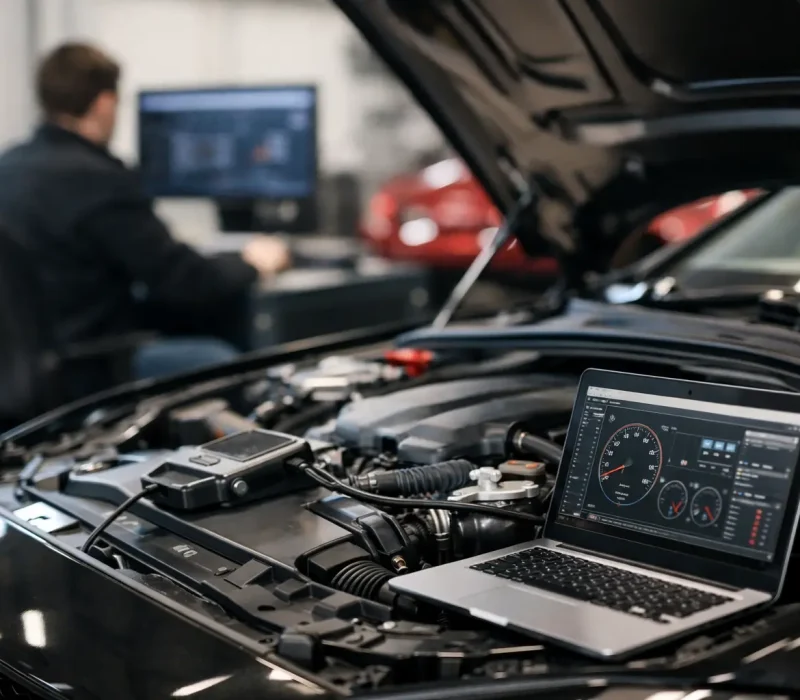



A loss of pull at low revs, hesitant acceleration and worsening fuel economy can all point to carbon deposits. But carbon cleaning vs walnut blasting is not a simple choice between a basic and premium service. They work in different ways, target different areas of the engine and suit different vehicles. Choosing the wrong method can mean paying for a clean that cannot reach the deposit causing the problem.
For drivers who rely on their car or van for commuting, motorway miles, towing or work, the aim is straightforward: restore smooth airflow and reliable performance without unnecessary strip-down or downtime. A proper diagnosis should come before any cleaning recommendation.
What carbon cleaning usually means
“Carbon cleaning” is a broad term. It may describe a chemical treatment introduced through the intake system, a fuel-system cleaner, or a professional decarbonising process designed to reduce deposits in areas exposed to the treatment. The method matters far more than the label.
A professional intake or engine carbon clean is commonly used to address contamination in the air path, inlet tract, EGR-related areas and combustion process. On suitable engines, it can help improve throttle response, restore smoother running and reduce the sluggish feeling that often develops after repeated short journeys.
It is generally the less invasive option. There is usually no need to remove the inlet manifold, making it a practical solution where deposits are light to moderate, access is limited, or the symptoms point to contamination elsewhere in the system rather than heavy deposits directly on the intake valves.
That convenience does not mean it is a cure for every running issue. A chemical process cannot physically scrub away every thick, baked-on layer of carbon. If deposits are severe or sit behind closed intake valves, its effect may be limited.
How walnut blasting works
Walnut blasting is a mechanical cleaning process used mainly on direct-injection petrol engines. The inlet manifold is removed to expose the intake ports and valves. Crushed walnut shell media is then blasted at controlled pressure to break up and remove carbon from the valve surfaces and ports, while each cylinder is positioned carefully so media does not enter the combustion chamber.
The shell media is hard enough to lift carbon but soft enough not to damage metal components when the work is carried out correctly. It is a precise, labour-intensive job rather than a quick additive or intake treatment.
Its principal advantage is reach. Direct-injection petrol engines inject fuel straight into the combustion chamber, so petrol does not wash over the back of the intake valves. Oil vapour from the crankcase ventilation system and EGR contamination can therefore build up on those valves over time. Walnut blasting tackles those deposits directly.
On an engine with heavily restricted intake valves, the difference can be substantial. Idle quality may improve, acceleration can feel cleaner, and lost power caused by restricted airflow may return. However, it will not repair worn timing components, a failed ignition coil, a split boost hose or an injector fault. It solves carbon contamination, not every cause of poor performance.
Carbon cleaning vs walnut blasting: the key differences
The biggest difference is physical contact. Carbon cleaning uses chemistry and controlled intake treatment to loosen or reduce deposits in areas the treatment can reach. Walnut blasting removes deposits mechanically from exposed intake ports and valves.
That makes walnut blasting the more thorough option for severe intake-valve carbon on many direct-injection petrol engines. It also makes it more involved. The inlet system must be dismantled, refitted correctly and checked for leaks afterwards. Labour time, access and engine layout all affect the cost.
Carbon cleaning is often the more sensible first route when the vehicle has mild symptoms, the deposit location is uncertain, or diagnostics suggest a wider intake and combustion cleanliness issue. It can also be more convenient for owners who need an efficient on-site appointment rather than a lengthy workshop strip-down.
Neither service should be sold as a universal upgrade. The right choice depends on the engine design, mileage, driving pattern, fault codes and the condition confirmed during diagnosis.
Which engines benefit most from each method?
Direct-injection petrol engines are the clearest case for walnut blasting. Many turbocharged petrol engines use direct injection and can develop intake-valve deposits, particularly when used for short trips, stop-start driving or frequent cold running. A vehicle may still drive reasonably well while deposits build, then gradually become less responsive or develop an uneven idle.
Port-injected petrol engines are less likely to need walnut blasting because fuel passes over the intake valves and provides a degree of cleaning. They can still suffer from carbon elsewhere, so a targeted carbon-cleaning treatment may be more appropriate depending on the symptoms.
Diesel engines need a different conversation. Carbon contamination in a diesel often involves the EGR system, intake manifold, swirl flaps, turbo air path and DPF-related operation. Walnut blasting is not automatically the answer. A blocked DPF, for example, needs proper assessment and an appropriate DPF cleaning process, not an intake-valve clean.
For diesel owners, especially high-mileage drivers and light commercial operators, recurring warning lights or limp mode should never be dismissed as “just carbon”. Differential pressure readings, soot load, regeneration history, intake condition and stored fault codes all matter. Cleaning may restore performance, but it must address the actual restriction.
Signs that warrant a proper inspection
Carbon-related issues can overlap with many other faults. A diagnostic check is worthwhile if you notice several of the following symptoms:
- Flat acceleration or delayed throttle response
- Uneven idle, hesitation or occasional misfires
- Reduced MPG without an obvious change in driving habits
- DPF, engine-management or emissions warnings
- Frequent failed regenerations or limp-mode operation
- Excessive smoke, although this can also indicate fuelling or turbo faults
These signs do not automatically prove carbon build-up. A quality diagnostic process checks live data and fault codes before recommending work. This protects you from spending money on cleaning when the underlying problem is an air leak, sensor issue, injector problem or mechanical fault.
Cost, downtime and the value of getting it right
Carbon cleaning is typically less expensive and quicker because it does not require major intake dismantling. That makes it attractive for vehicles with early symptoms, preventative maintenance needs or deposits in areas responsive to the treatment.
Walnut blasting generally costs more because of the preparation, manifold removal, cylinder-by-cylinder process and reassembly. On the right direct-injection engine, though, it can offer better value than repeated chemical treatments that cannot fully remove thick valve deposits.
The cheapest option is not always the economical one. A low-cost cleaner added without diagnosis may do very little for a vehicle with severe intake restriction. Equally, a full walnut-blast service is unnecessary if the issue is a DPF pressure fault or a failing boost-control component. The saving comes from matching the method to the fault first time.
What a safe professional process looks like
Cleaning work should begin with vehicle-specific checks, not a generic promise of more power. The technician should establish the engine type, review fault codes, assess running symptoms and identify whether carbon is likely to the main restriction.
For walnut blasting, safe working practices include controlled media use, correct cylinder positioning, protection of the ports, thorough vacuum extraction and careful reassembly. Any intake seals disturbed during the work should be inspected and replaced where necessary. A post-work check for air leaks and fault codes is equally important.
For chemical carbon cleaning, the treatment must be compatible with the vehicle and applied at the correct rate. Overpromising is a warning sign. A professional will explain what the process can improve, where it has limits and whether a more involved mechanical clean is likely to be required.
At High REVS Performance, the same principle applies to carbon cleaning, DPF work and diagnostics: use the evidence from the vehicle, then recommend the least invasive solution that can realistically solve the problem. Mobile service across Tamworth and Staffordshire can save the inconvenience of a garage visit, but it should never replace proper technical assessment.
Make the decision from evidence, not the service name
If you own a direct-injection petrol car with confirmed heavy intake-valve deposits, walnut blasting may be the most effective route. If your vehicle has lighter contamination, a different engine design or symptoms linked to broader intake and combustion deposits, professional carbon cleaning may be the sensible place to start.
Before authorising either service, ask what area is being cleaned, how the technician has identified the problem and what result is realistic for your engine. That conversation is often more valuable than choosing a method by price alone – and it gives your vehicle the best chance of returning to the smooth, dependable performance you expect.