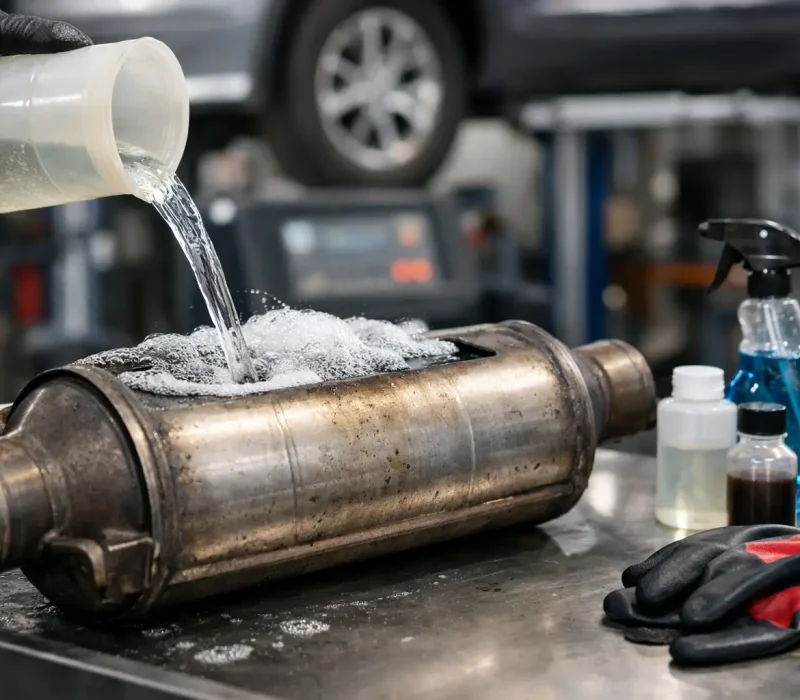



A search for “faq dpf cleaning how long lasts” usually comes after the DPF warning light appears, power drops or the vehicle enters limp mode. The honest answer is that a professional DPF chemical clean can last many months or years, but only when the reason for the blockage has been identified and addressed. Cleaning restores the filter’s flow. It cannot cure an engine fault that is continually producing too much soot.
For drivers covering the Tamworth and Staffordshire area, the most useful question is not simply how long a clean lasts. It is whether the DPF is blocked by normal use, or whether another issue is loading it up faster than it should.
How long does DPF cleaning last?
On a healthy diesel that regularly reaches full operating temperature, a properly cleaned DPF may remain clear for a long time – commonly years rather than weeks. A car used mainly for longer commuting or motorway journeys gives the engine enough time to complete passive and active regenerations, which helps prevent soot from building up again.
For a vehicle used almost entirely on short, low-speed trips, the outcome can be very different. Repeated school runs, town driving and stop-start delivery work can interrupt regeneration before the DPF gets hot enough to burn accumulated soot away. In that situation, a clean may restore performance immediately, but the filter can become restricted again within months if nothing changes.
Mileage alone is not the deciding factor. A high-mileage motorway car can have a healthier DPF than a low-mileage car that never gets a sustained run. Engine condition, driving pattern and the quality of the diagnosis matter far more than the number on the odometer.
What determines how long a DPF clean lasts?
A diesel particulate filter collects soot as part of normal operation. During regeneration, exhaust temperatures rise and that soot is burned away. Over time, non-combustible ash from oil additives also remains in the filter. Chemical cleaning is designed to break down and remove soot deposits, helping restore exhaust flow and allowing the system to work as intended.
However, a blockage is often a symptom rather than the original problem. If a fault remains, the newly cleaned DPF may load up again sooner than expected. Common causes include a sticking EGR valve, failed temperature or pressure sensor, boost leak, injector issue, thermostat that prevents the engine reaching temperature, or excessive oil consumption.
The following factors have the greatest influence on lifespan:
- Driving routine: Regular longer journeys support successful regeneration. Continuous short trips work against it.
- The cause of the restriction: A DPF blocked through interrupted regens is different from one affected by a sensor fault or excessive soot production.
- Ash level: Ash cannot be burned away during a normal regeneration. At higher mileages, it may limit how much useful capacity the filter has left.
- Maintenance quality: Correct low-SAPS engine oil, timely servicing and resolving warning lights promptly all protect the DPF.
- Vehicle use: Towing, heavy loads and fleet work can be perfectly manageable, but they place more demand on the engine and make preventative maintenance more valuable.
This is why a professional service should start with diagnostics rather than treating the warning light as proof that the DPF itself has failed.
Chemical cleaning, regeneration and replacement are not the same
These terms are often used interchangeably, but they describe different solutions.
A forced regeneration uses diagnostic equipment to command the vehicle to raise exhaust temperatures and burn soot off. It can work well when the soot level is safe and the vehicle has no underlying fault. It is not suitable for every blockage, particularly where soot loading is excessive or fault codes point to another issue.
DPF chemical cleaning introduces specialist cleaning fluid through the appropriate system route to loosen soot deposits and improve flow through the filter. This is often a practical option for a restricted DPF where removal and replacement would be unnecessarily expensive. Done correctly, it is followed by checks of pressure readings, live data and regeneration operation, not simply clearing the fault codes and sending the vehicle away.
Replacement is sometimes necessary. A cracked, melted or physically damaged DPF cannot be repaired with chemicals. Nor can cleaning reverse every case of severe ash accumulation. A transparent diagnosis should make that clear before work begins, rather than promising a guaranteed result where the filter or supporting engine systems are beyond a sensible repair.
Signs your DPF may block again too soon
A warning light returning shortly after a clean is not normal, and it should not be ignored. It may mean the vehicle has resumed only short journeys, but it may also point to a fault that needs attention.
Look out for reduced acceleration, poor fuel economy, cooling fans running after the ignition is switched off, higher idle speed, a strong hot exhaust smell, frequent regeneration attempts or the engine management light joining the DPF warning. On some vehicles, repeated failed regenerations can allow diesel fuel to dilute the engine oil. If the oil level rises, avoid continuing to drive the vehicle until it has been assessed.
Limp mode is particularly worth acting on promptly. The vehicle is limiting power to protect itself, and continuing to work it hard can turn a manageable maintenance job into a much larger repair bill.
How to make DPF cleaning last longer
Once the filter is clean and the vehicle has been confirmed healthy, the best protection is allowing it to regenerate properly. A regular 20 to 30-minute drive at steady road speed can help many diesels, provided the engine is fully warm and there are no active faults. This is not a substitute for diagnosis, but it supports normal DPF operation.
Use the manufacturer-specified low-ash oil at every service. The wrong oil increases ash deposits that remain in the DPF permanently. It is also wise not to ignore a thermostat fault just because the cabin heater still feels warm. If the engine runs cooler than intended, regeneration may not complete reliably.
Drivers who mainly cover short distances should be realistic about their vehicle’s use. A modern diesel is efficient and capable, but it is less suited to constant cold starts and brief urban runs than to regular longer journeys. If that driving pattern cannot change, early diagnostic checks at the first sign of trouble are far cheaper than waiting for full blockage.
Why diagnostics protect the value of a DPF clean
At High REVS Performance, DPF cleaning is approached as a maintenance and diagnostic job, not a quick fault-code clear. Before recommending a clean, live data such as DPF differential pressure, exhaust temperatures, soot loading and relevant fault codes should be considered. These readings help establish whether cleaning is appropriate and whether the engine is capable of regenerating afterwards.
This matters because a clean can provide excellent value when it prevents premature DPF replacement. Equally, it is poor value if the real cause is a failed sensor, an air leak or a fuelling problem left unresolved. Mobile diagnostics and treatment at your home or workplace can save the inconvenience of arranging a garage visit, but the technical process should remain thorough.
A DPF clean lasts longest when it is part of the right repair, not a shortcut around one. If the warning light is on, arrange an assessment while the issue is still limited to restricted flow and incomplete regeneration. Acting early gives the filter, the engine and your wallet the best chance of a straightforward outcome.