


A warning light appearing on the way to work is inconvenient enough. Being told only that your car has a “sensor fault” after plugging in a cheap scanner is often more frustrating still. At High REVS Performance, our mobile diagnostics service across Tamworth and Staffordshire shows why mobile diagnostics versus code readers is not a like-for-like comparison: one identifies a stored message, while the other investigates what caused it.
A code reader can be useful for a quick first look. Proper diagnostics are what turn that first clue into a credible repair decision, whether the issue is a DPF warning, poor fuel economy, limp mode or a vehicle that no longer pulls as it should.
What a code reader actually tells you
Most basic OBD code readers plug into the diagnostic port and retrieve fault codes from the engine control unit. For example, they may display a code relating to low turbo boost, an EGR flow issue, a DPF pressure reading or a cylinder misfire.
That information has value. It confirms that the ECU has seen a condition outside its expected range and has recorded it. It can also let a driver clear a warning temporarily after a minor issue has been addressed. But the code is not usually a parts list.
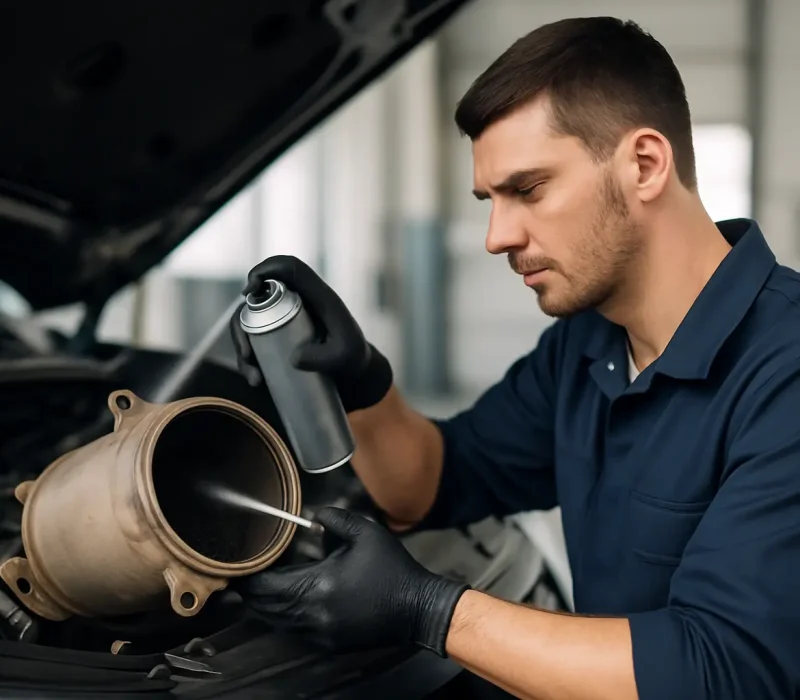
Take a DPF-related fault. A reader may report a differential-pressure sensor code or a warning that the filter is overloaded. That does not automatically mean the sensor has failed or that the DPF needs replacing. The underlying issue could be a split pressure hose, repeated interrupted regenerations, a temperature sensor giving implausible readings, excessive soot from an air or fuelling problem, or a filter that genuinely needs professional chemical cleaning.
Clearing the code without finding the cause often means the warning returns. In some cases, it returns at the worst possible moment – during a commute, delivery round or towing trip – and the vehicle drops into reduced-power mode.
Mobile diagnostics versus code readers: the practical difference
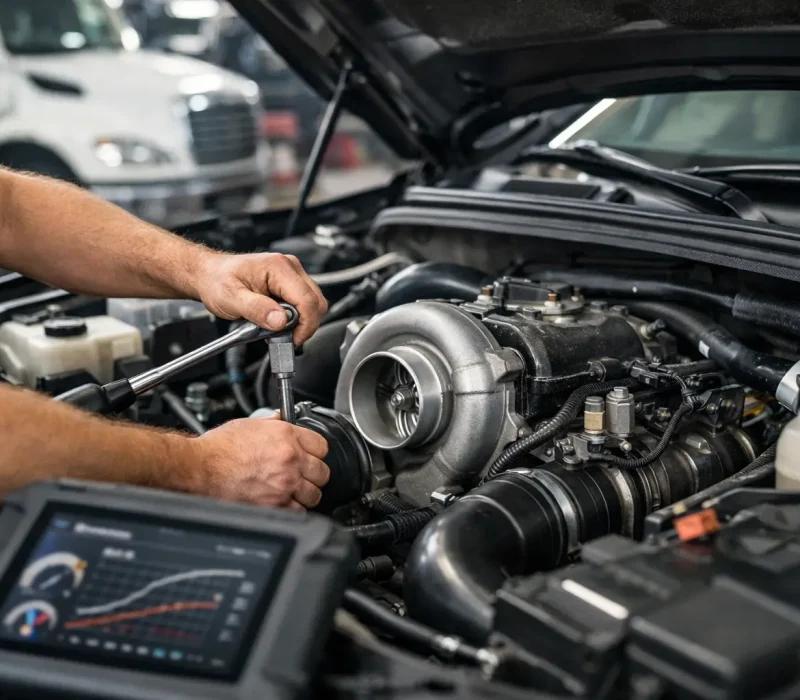
A proper diagnostic appointment is an investigation, not a five-minute scan. The technician reads the codes, but also looks at the operating conditions recorded when the fault occurred and compares live values with what the ECU should be seeing.
This can include checking live data for boost pressure, airflow, injector correction values, fuel-rail pressure, EGR commanded versus actual position, coolant temperature, exhaust-gas temperatures and DPF soot loading. The exact checks depend on the vehicle and fault, rather than following a generic checklist.
Professional-level equipment can also access more vehicle modules than an entry-level reader. Modern cars commonly hold useful fault information in transmission, ABS, body-control, parking, steering and emissions systems, not only the engine ECU. Where supported, active tests can command components to operate so their response can be checked rather than guessed.
The difference is simple: a code reader says, “the ECU noticed this.” Diagnostics ask, “why did it notice it, is the fault current, and what evidence supports the repair?”
That matters before money is spent. Replacing a sensor because its circuit code appeared may fix the car, but it may also leave the real problem untouched if the wiring, connector, vacuum supply or related mechanical component is at fault.
A typical diesel job: warning light, weak pull, no clear answer
A common local call-out is a diesel estate or van used for daily motorway miles and school runs, often a Ford Kuga, Volkswagen Passat or similar Euro 6 vehicle. The owner has a DPF warning, the engine feels flat above 2,000rpm, and a handheld reader has produced a DPF-pressure code.
On a job like this, the sensible next step is not to order a pressure sensor immediately. We would assess the stored information, then check live differential pressure at idle and under suitable engine speed, soot and ash estimates, recent regeneration history, exhaust temperatures and any supporting faults affecting airflow or combustion.
If readings show a genuinely restricted DPF and the rest of the system is functioning correctly, DPF chemical cleaning may be the sensible route. It can restore flow and help prevent the cost and disruption of unnecessary filter replacement. If the pressure reading is implausible or does not change logically with engine speed, attention shifts to the sensor, its hoses and its wiring. The same fault code can lead to two very different repairs.
That is why drivers should be cautious of anyone who promises a diagnosis from one code alone. The vehicle’s data, condition and usage pattern decide the next step.
When a basic reader is still useful
There is no need to dismiss code readers entirely. Keeping one in the glovebox can be helpful for an owner who wants an early indication of why an engine management light has appeared. It can be particularly useful before calling for assistance, as long as the result is treated as information rather than a verdict.
A reader is most useful when it helps you report clear symptoms: the warning light came on after a long run, the car is smoking under load, it has limited power, or it struggles to regenerate. Avoid repeatedly clearing codes just to make the dashboard light disappear. Stored and pending codes, along with freeze-frame data, can help trace an intermittent fault. Erasing them may remove useful evidence.
If the car drives normally and the code relates to a known minor issue, you may choose to monitor it. If there is reduced power, excessive smoke, a flashing warning light, overheating or a DPF warning that will not clear, book diagnostics before continuing to use the vehicle heavily.
Why diagnostics matter before a Stage 1 remap
A Stage 1 remap should improve usable torque, throttle response and, for the right driver, fuel economy. It is not a cure for an underlying mechanical or emissions-system fault. Applying extra load demand to a vehicle already struggling with boost control, fuelling, airflow or DPF restriction is not responsible tuning.
Before any custom-written ECU calibration, the vehicle needs to be in suitable health. A scan for current and historic faults is part of that picture, but proper assessment goes further when something does not add up. A low-boost code on a diesel, for instance, could come from a loose intercooler hose, actuator issue, vacuum leak, sticking vane mechanism or sensor signal. The remap must wait until the cause is understood and rectified.
This approach protects the customer and the vehicle. It also means the result of an Eco, Balanced or Stage 1 Power remap is based on a sound platform, using a calibration written within sensible manufacturer tolerances rather than a generic file used to mask a problem.
The advantage of having diagnostics brought to you
For many drivers, the real difficulty is not deciding whether a dashboard warning needs attention. It is finding time to lose the car for a garage visit, especially when it is needed for work, family commitments or a small business fleet.
Mobile diagnostics bring the investigation to your home or workplace. That is particularly useful when a vehicle remains driveable but unreliable, or when intermittent symptoms are easier to discuss and assess where the car is normally used. You can explain exactly when the fault occurs, whether it happens during motorway cruising, urban journeys, towing or cold starts.
Convenience does not mean shortcuts. The aim is dealer-level fault finding carried out at your location, with a clear explanation of what the data shows, what is confirmed, what still needs checking and which repair route makes financial sense.
Do not pay for a guess
A fault code is a starting point, not permission to replace parts at random. For some vehicles, a simple code reader gives enough reassurance to monitor a minor issue. For warning lights, repeated DPF faults, poor performance or preparation for a remap, the evidence from proper diagnostics is worth far more than the cost of guessing.
If your vehicle has a warning light, DPF concern, limp-mode issue or unexplained loss of power, book a mobile diagnostic appointment with High REVS Performance. We can assess it at your Tamworth or Staffordshire home or workplace, identify the sensible next step, and advise whether DPF chemical cleaning or further repair is needed before you spend money.