


That engine management light rarely appears at a convenient time. You notice a loss of power on the way to work, the car drops into limp mode, or a DPF warning flashes up before a long run. At that point, understanding how home car diagnostics work can save time, avoid guesswork, and stop you spending money on parts the vehicle never needed.
Modern vehicles constantly monitor how their engine, emissions system and supporting components are performing. When something drifts outside the values the ECU expects, the car stores a fault code and, in many cases, switches on a warning light. Home diagnostics simply means reading that information where the vehicle is parked, rather than taking it into a workshop first.
How home car diagnostics work in practice
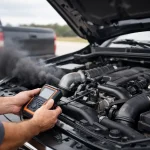
Every modern car has control units that manage key systems such as fuelling, boost pressure, ignition timing, emissions control and sensor feedback. These modules communicate through the vehicle’s onboard diagnostic system, usually accessed through the OBD port. A professional diagnostic tool plugs into that port and requests stored information from the car’s control units.
That sounds straightforward, but the real value is not just in reading a code. A fault code is a starting point, not a full diagnosis. For example, a code relating to boost pressure does not automatically mean the turbocharger has failed. It could point to a boost leak, a sticking actuator, a split hose, a sensor reporting incorrectly, or a control issue elsewhere in the system.
A proper home diagnostic visit looks at live data as well as stored codes. That means checking what the engine is doing in real time – air mass readings, fuel trims, rail pressure, boost targets, DPF soot load, exhaust gas temperatures and other values relevant to the fault. This is how a technician separates a symptom from the actual cause.
What the diagnostic tool is really reading
The OBD port gives access to data, but the quality of the answer depends on the quality of the equipment and the person using it. Basic code readers can pull generic fault codes, clear warning lights and offer a short text description. That may be enough if the issue is very simple, but it often falls short on newer diesels, turbo petrols and vehicles with manufacturer-specific systems.
Professional equipment goes further. It can access more modules, read manufacturer-level fault information, view live parameters in detail, and in some cases carry out actuator tests or service functions. If a diesel has DPF issues, for instance, it helps to see differential pressure readings, regeneration history, calculated soot loading and temperature sensor performance rather than just a generic emissions code.
That matters because many warning lights are consequences, not causes. A blocked DPF might be the visible problem, but the reason it blocked could be poor combustion, repeated short journeys, a faulty sensor, an EGR issue or excessive carbon build-up affecting airflow. Reading the code alone can miss that bigger picture.
Why warning lights and fault codes can be misleading
One of the biggest misunderstandings in vehicle diagnostics is assuming the code names the failed part. It often does not. The ECU only knows that a signal, value or system response is outside its expected range. It does not think like a technician.
Take a mass airflow fault. That can point to a failed sensor, but it can also be caused by an air leak, a heavily contaminated intake system, a restricted filter, wiring faults or carbon build-up affecting airflow. The same applies to EGR, DPF and turbo-related faults. Replace the named part without proper testing and you can spend a lot without fixing the vehicle.
This is where home diagnostics earns its keep. A technician can assess the code, look at the live data behind it, check the car’s symptoms, and decide whether the issue is electrical, mechanical or operational. Sometimes the result is a simple repair. Sometimes it highlights a maintenance issue that has built up over time, especially on modern diesels used mainly for short local trips.
How mobile diagnostics compares with a garage visit
For many drivers, the practical advantage is obvious. If the car is in limp mode, showing an emissions warning, or not driving properly, arranging a home or workplace diagnostic appointment avoids the hassle of taking time out to sit at a garage waiting room. For business users, commuters and light fleet operators, that convenience matters.
There is also a technical advantage in some cases. Diagnosing the vehicle where it normally operates can help build a clearer picture. If a van only shows a fault after repeated stop-start use, or a diesel owner mainly does short-distance commuting, the technician can relate the fault pattern to actual use rather than treating it as an isolated event.
That said, home diagnostics has limits. Some faults need a ramp inspection, smoke testing, strip-down work or component replacement that cannot sensibly be done on every driveway. A good diagnostic process should be honest about that. The aim is to identify the issue properly and explain the next step clearly, whether that is an on-site fix, a further test, or workshop-based repair.
How home car diagnostics work for diesel faults
Diesel vehicles are a common case because modern emissions systems are effective when everything is healthy, but less forgiving when driving habits or underlying faults interfere. DPF blockage, failed regenerations, EGR faults and carbon-related running issues often build gradually before the warning lights appear.
Home diagnostics on a diesel usually focuses on how the engine is breathing, fuelling and managing its emissions load. That includes checking whether the DPF is genuinely full, whether the sensors reporting DPF condition are believable, whether exhaust temperatures are reaching regeneration levels, and whether another fault is preventing the system from cleaning itself.
If the vehicle has become sluggish, smokes more than usual, or keeps requesting regeneration, the answer may not be a new DPF. It may be a pattern of short journeys, excessive soot production, intake contamination or a sensor issue. This is why proper testing matters before expensive parts are recommended.
When a code clear is the wrong answer
Clearing fault codes has its place after repair or when confirming whether a fault returns. Using it as a shortcut is another matter. If the root cause is still there, the warning light usually comes back – sometimes quickly, sometimes after a drive cycle or two.
More importantly, clearing a code without understanding it can delay action on a problem that is getting worse. A car with low boost, poor fuel delivery, failed regeneration attempts or misfire-related emissions issues may continue to run, but performance, economy and reliability can deteriorate in the background.
A professional approach is to treat code clearing as the final stage of diagnosis or repair, not the first. If a warning light is removed too early, useful evidence can be lost.
What a technician is looking for beyond the scanner
The scanner is essential, but it is only one part of the job. Good diagnostics also relies on pattern recognition, mechanical understanding and experience with the way common faults show up on specific engine types.
A technician will usually connect the symptoms to the data. Is the loss of power constant or intermittent? Does it happen under load? Is the idle uneven? Has fuel economy dropped off? Is there a history of short trips, towing, motorway use or repeated interrupted regenerations? Those details shape the diagnosis.
This is particularly relevant for owners considering related services such as carbon cleaning, DPF cleaning or ECU work. If the car feels flat, hesitates or no longer pulls cleanly, diagnostics helps confirm whether the issue is maintenance-related, component-related or calibration-related. Guessing helps no one.
When home diagnostics makes the most sense
If the vehicle still starts and can be accessed safely, home diagnostics is often the most efficient first move for warning lights, limp mode, poor performance, DPF concerns and recurring fault codes. It is especially useful when you want a clear answer before committing to repairs.
For drivers around Tamworth and wider Staffordshire, that means less downtime and less disruption to the working day. You get the convenience of mobile service, but the process still needs to be dealer-level in its method – proper tools, proper data, and a diagnosis based on evidence rather than assumptions.
The most useful thing diagnostics gives you is clarity. Not just what code is stored, but why the car set it in the first place, how serious it is, and what should happen next. That is often the difference between a quick, sensible repair and an expensive round of parts swapping that never fully solves the fault.
When a warning light appears, the best next step is not to panic and not to guess. Let the vehicle tell its story properly, because modern cars usually do – if you read the data the right way.