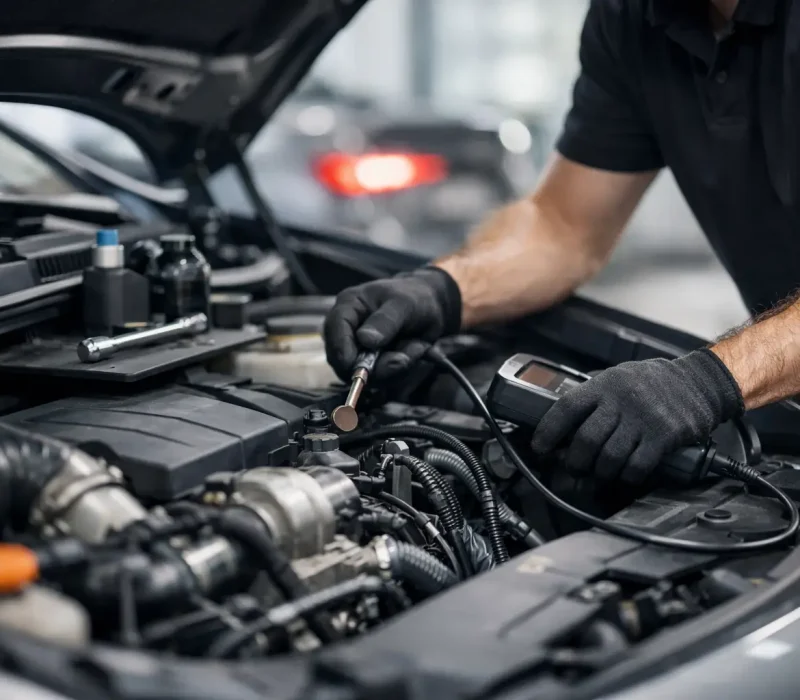



A fault code tells a technician where the engine management system has seen a problem. Live data helps show why it happened. This guide to live data diagnostics explains how real-time readings turn an illuminated engine light, poor MPG or limp mode into a clearer, evidence-based repair decision.
For modern petrol and diesel vehicles, replacing parts from a code alone can be expensive guesswork. A mobile diagnostic visit should look beyond the stored code, checking the values the vehicle is reporting while the engine is cold, at idle and, where suitable, under load. That approach can save time, avoid unnecessary parts and help prevent a minor fault from becoming a larger repair.
What live data diagnostics actually means
Live data is the stream of information sent by sensors and control modules around the vehicle. Using professional diagnostic equipment, a technician can read values from the engine ECU and, depending on the vehicle, the transmission, ABS, body control module and other systems.
These readings may include coolant temperature, boost pressure, fuel rail pressure, airflow, injector corrections, oxygen sensor activity, DPF soot loading and exhaust gas temperatures. The useful part is not simply seeing a number on a screen. It is comparing that number with the ECU’s request, the manufacturer’s expected operating range and the readings from related sensors.
For example, if the ECU requests more turbo boost but the actual boost remains low, the cause could be a split boost hose, a vacuum-control issue, a sticking actuator, a sensor fault or a turbocharger problem. Live data helps narrow the possibilities before work begins.
Why a code reader is not always enough
Many basic readers can retrieve generic fault codes and clear the warning light. That can be useful, but clearing a code does not fix the condition that caused it. If the ECU sees the same issue again, the light will return and the vehicle may enter reduced-power mode.
A code such as low DPF efficiency, implausible airflow or fuel-pressure deviation can have several causes. The ECU has identified an abnormal result, not necessarily the failed component. Live readings provide the context: whether the engine was warm enough to regenerate, whether the pressure sensor is believable, whether the airflow figure follows engine demand, and whether a fault is current or historic.
This matters particularly for high-mileage diesels, cars used mainly for short journeys and light commercial vehicles that cannot afford unnecessary downtime. A proper diagnosis is often the difference between targeted maintenance and replacing a costly part that was not the root cause.
The key readings we check
The exact data list depends on the make, model, engine and complaint. A loss-of-power issue needs a different diagnostic path from a starting fault or an intermittent warning light. However, several readings regularly provide valuable answers.
DPF load and regeneration data
Diesel particulate filter faults are not always caused by a blocked filter. We look at calculated soot load, ash load where supported, differential pressure, regeneration status, distance since the last regeneration and exhaust temperatures.
A high differential-pressure reading at idle may point to a genuinely restricted DPF, but it can also be caused by damaged pressure pipes or a faulty differential-pressure sensor. Conversely, a vehicle may have a reasonable pressure reading but repeatedly fail regeneration because it is not reaching temperature, has an underlying EGR or boost issue, or is used almost entirely on short trips.
Chemical DPF cleaning can be a practical way to restore flow when the diagnosis supports it. It is not a substitute for fixing the reason the filter became overloaded in the first place.
Airflow, boost and EGR behaviour
Airflow and boost readings are central to diagnosing sluggish acceleration, black smoke, poor economy and reduced power. The ECU compares requested values with actual sensor feedback. When they do not track as expected, live data can direct testing towards the intake system, boost control, MAF sensor, MAP sensor, EGR system or exhaust restriction.
Carbon build-up can also affect how efficiently an engine breathes. On suitable engines, carbon cleaning may help restore airflow and drivability, but the readings and physical checks should support that recommendation. A cleaning service cannot repair a split hose, failed sensor or mechanical turbo fault.
Fuel pressure and injector correction values
Common-rail diesel and direct-injection petrol engines rely on accurate fuel delivery. Rail-pressure data shows whether the fuel system is achieving the pressure the ECU requests. Injector correction values can indicate how much the ECU is compensating to keep the engine running smoothly.
These figures need careful interpretation. One higher correction figure does not automatically mean an injector has failed. Engine temperature, battery voltage, fuel quality, compression, mileage and the values of all cylinders matter. A technician should assess the pattern rather than make a decision from one isolated number.
Temperature sensors and engine warm-up
Coolant, intake-air and exhaust-gas temperatures influence fuelling, regeneration and emissions control. An engine that appears to run normally may never reach proper operating temperature because of a thermostat issue. That can reduce economy and make DPF regeneration more difficult.
Temperature data is also useful when investigating fans running unexpectedly, hard starting, overheating warnings or regeneration concerns. A sensor that reads implausibly high or low can mislead the ECU and trigger further faults.
How live data is used during an on-site diagnosis
A useful diagnostic session starts with the driver’s experience. Whether the issue occurs cold, under hard acceleration, while towing, after motorway driving or only on short local trips affects what should be tested. Service history and recent repairs also matter, especially if the problem began after work was carried out.
The technician then performs a full system scan, records relevant fault codes and reviews freeze-frame information. Freeze-frame data is a snapshot of the operating conditions when a fault was stored, such as engine speed, temperature and load. It can be highly useful for intermittent problems.
Next comes live data. Readings are checked at sensible stages: ignition on, cold start, idle, raised revs and, where safe and appropriate, a road test. The aim is to reproduce the fault and observe the systems involved rather than rely on assumptions.
For mobile diagnostics in Tamworth and across Staffordshire, this can be particularly convenient. Your vehicle can be assessed at home or at work, reducing the inconvenience of arranging a garage visit when a warning light or limp-mode issue has affected the day.
A guide to live data diagnostics: limits and trade-offs
Live data is powerful, but it is not magic. Some faults are intermittent and may not occur during the appointment. Wiring faults can appear only with vibration, heat or moisture. A sensor can report a believable value while still responding too slowly under changing load.
That is why a professional diagnosis may include visual inspections, electrical checks, smoke testing, component tests or a further visit. The correct route depends on the evidence. Honest diagnostics means explaining when a reading strongly identifies the cause and when further testing is needed before recommending a repair.
It also means avoiding unnecessary fault-code clearing. Codes may be cleared after information has been recorded and work completed, but clearing them before diagnosis can remove evidence that helps identify the problem.
When diagnostics should come before a remap
An ECU remap should only be considered when the vehicle is mechanically sound and free from active engine-management issues. A Stage 1, Balanced or Eco calibration can improve torque, throttle response or fuel economy when custom-written within manufacturer tolerances, but it should not be used to mask a DPF, boost, fuelling or sensor fault.
If live data reveals poor airflow, excessive DPF pressure, inconsistent boost or fuel-pressure concerns, resolving those issues first protects the vehicle and gives the calibration a proper foundation. The same applies to a vehicle that has entered limp mode. Restoring reliable operation comes before pursuing performance.
A good diagnostic result is not always the most dramatic one. Sometimes it confirms that a warning was caused by a sensor hose, a thermostat or a driving pattern that has prevented regeneration. That clarity lets you spend money where it will make a genuine difference – and keep your vehicle dependable for the commute, the school run, towing work or the next long motorway journey.