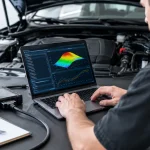


A vehicle that suddenly feels flat on the A5, struggles to pull when loaded, or drops into limp mode on the school run needs more than a guess. At High REVS Performance, our mobile service across Tamworth and Staffordshire starts by finding the actual restriction or fault at your home or workplace. When drivers ask about the top causes engine power loss, the answer is often tied to the air, fuel and emissions systems that modern engine management is designed to protect.
A warning light can help point the way, but it does not automatically identify the failed part. Low power may be caused by a blocked DPF, a split boost hose, a sensor reporting implausible readings, or carbon restricting airflow. Replacing parts before checking live data can become expensive very quickly. Proper on-site diagnostics give us the evidence to decide whether a DPF chemical clean, a repair, or a later remap is the right route.
Top causes of engine power loss on modern vehicles
DPF loading and failed regeneration
For many diesel owners, a loaded diesel particulate filter is the most common reason for a marked loss of power. The DPF stores soot and normally clears it through regeneration when the vehicle reaches suitable exhaust temperatures. Repeated short trips, stop-start commuting and interrupted regeneration cycles can prevent that process from finishing.
As soot loading rises, exhaust back pressure rises with it. The ECU may then limit torque to protect the engine and exhaust system. You may notice sluggish acceleration, poor fuel economy, a DPF or engine management warning, a cooling fan running after the ignition is switched off, or limp mode under hard acceleration.
A motorway run occasionally helps a vehicle that is only beginning to load up, but it will not solve every DPF fault. A filter with high ash content, a pressure-sensor issue, an EGR-related fault or a failed regeneration history needs diagnosis first. Our mobile DPF chemical cleaning service is designed to remove soot deposits professionally and restore exhaust flow where the filter is suitable for cleaning, helping to avoid the cost and inconvenience of premature DPF replacement.
Boost leaks and turbo control faults
Turbocharged petrol and diesel engines rely on pressurised intake air to make their expected torque. A cracked intercooler hose, loose clip or split pipe can allow boost pressure to escape. The result is often a noticeable hiss under load, slower pickup, smoke on a diesel, and reduced pulling power when overtaking or towing.
The fault is not always a visible split. Vacuum lines, boost-control solenoids, turbo actuators and manifold pressure sensors all affect how accurately boost is controlled. If commanded boost and actual boost do not match, the ECU can reduce fuelling and place the vehicle in a protective reduced-power mode.
This is why a generic code-reader result is not the finish line. During an on-site diagnostic appointment, live readings can show whether the turbo is being asked to produce pressure, whether it is achieving it, and whether the sensor information makes sense. That distinction prevents a boost leak being mistaken for a failed turbocharger.
Carbon buildup restricting intake airflow
Carbon buildup is especially relevant on diesels and direct-injection engines used mainly for local journeys. Deposits around the EGR system and intake tract can gradually reduce the clean airflow available to the engine. The change is rarely instant. Drivers often describe it as the vehicle becoming less responsive over months, using more fuel and feeling unwilling at lower revs.
When airflow is restricted, the ECU cannot deliver power as cleanly or efficiently as it should. On a diesel, excess deposits can also contribute to poor combustion and more soot production, adding further pressure to the DPF system. Engine carbon cleaning is therefore not a cosmetic add-on. On the right vehicle, it can support smoother running, sharper throttle response and a more effective airflow path.
It depends on the fault, however. Carbon cleaning will not repair a split hose, a worn turbo or an electrical sensor failure. We use diagnostic findings and the vehicle’s symptoms to establish whether deposits are genuinely part of the problem before recommending work.
Fuel delivery and sensor faults
An engine needs the correct fuel pressure and accurate sensor feedback before it can deliver full torque. Faulty mass airflow sensors, MAP sensors, fuel-pressure sensors and temperature sensors can all send readings outside the expected range. Sometimes they trigger a warning light. In other cases, the car simply feels dull because the ECU is working from unreliable information.
Fuel supply issues can create a similar feeling. Restricted fuel filters, injector performance concerns and low rail-pressure faults may cause hesitation, difficult starting or a lack of power under load. These issues matter to high-mileage drivers and light commercial operators because the vehicle may run acceptably around town but struggle as soon as it is asked to carry tools, passengers or a trailer.
The useful question is not just, “What fault code is stored?” It is, “What was happening when the fault occurred, and do the live figures support it?” That is the value of professional mobile diagnostics rather than changing the first component named by a code description.
A typical local power-loss diagnosis
Consider a 2017 Ford Transit 2.0 TDCi used by a Tamworth tradesperson. It drives normally for short distances but loses power on the dual carriageway with a full load, then clears after the ignition is cycled. The owner may understandably suspect the turbo.
At the vehicle, an initial scan could show a DPF-related pressure fault and an underboost code. Live data might then reveal that exhaust back pressure is excessive because the DPF is heavily soot-loaded, while the turbo is responding as expected. In that case, fitting a turbocharger would not address the cause. A suitable DPF chemical clean, followed by confirmation of pressure readings and fault status, can restore the flow the engine needs.
That example also shows why symptoms can overlap. A restriction in the exhaust can look like a boost problem, and a boost problem can increase soot production that later affects the DPF. Checking the whole picture saves downtime and helps protect your budget.
Can a Stage 1 remap fix lost power?
A Stage 1 ECU remap is built to improve torque delivery, throttle response and usable performance when the vehicle is mechanically healthy. It is not a substitute for solving a fault. Applying more requested torque to an engine with a blocked DPF, boost leak or sensor problem can mask the underlying issue for a short time or make protective intervention more likely.
The right order is straightforward: diagnose the reason for the power loss, correct it, then assess whether a custom-written remap suits how you use the vehicle. For a motorway commuter, an Eco or Balanced calibration may prioritise stronger low-rev torque and potential fuel-saving benefits. For towing, carrying loads or simply wanting a more engaging drive, a safe Stage 1 Power remap can make the vehicle feel far more willing without working outside manufacturer tolerances.
Every calibration should be specific to the vehicle, its condition and its intended use. High REVS Performance uses genuine professional tools and custom-written software rather than an off-the-shelf file, because reliable gains matter more than headline numbers.
When to book diagnostics rather than keep driving
Do not ignore recurring limp mode, a flashing or persistent engine warning light, a DPF warning, sudden smoke, or a clear drop in fuel economy. Continuing to drive may be possible in some cases, but it can turn a cleanable restriction into a more costly repair and can leave you stranded when the vehicle finally limits power completely.
Book a mobile diagnostic appointment with High REVS Performance at your home or workplace in Tamworth or Staffordshire. We can identify the cause of your lost power and advise clearly whether a DPF chemical clean, carbon cleaning, repair path or a safe ECU remap is the practical next step.