



That amber DPF light rarely appears at a convenient time. Usually it shows up when the car has been doing short school runs, stop-start commuting or local delivery work, and before long you notice poor throttle response, rising fuel use or the engine dropping into limp mode. This guide to diesel DPF regeneration explains what is actually happening inside the filter, why some vehicles recover with the right drive cycle and why others need a proper diagnostic and chemical clean.
What diesel DPF regeneration actually means
A diesel particulate filter, or DPF, is designed to trap soot produced during normal diesel combustion. Over time, that soot has to be burned off, otherwise the filter loads up, exhaust back pressure rises and the engine can no longer operate efficiently.
That burn-off process is regeneration. In simple terms, the vehicle raises exhaust temperatures high enough to turn trapped soot into ash and gas. Soot can be removed through regeneration. Ash cannot. That matters, because a DPF can often be recovered when soot loading is the issue, but a heavily ash-loaded or physically damaged filter may be a different conversation entirely.
For most owners, the confusion comes from the fact that regeneration is not one single process. There are several types, and each tells you something about how blocked the system really is.
The main types of DPF regeneration
Passive regeneration
Passive regeneration happens when exhaust temperatures are naturally high enough for soot to burn off during normal driving. A steady motorway run or an A-road journey at consistent speed is the classic example. If your diesel regularly does longer trips under load, the DPF has a better chance of keeping itself under control.
This is why some drivers never seem to have DPF trouble, while others deal with repeat warning lights. It is not always about vehicle quality. Often, it is simply about usage pattern.
Active regeneration
Active regeneration is triggered by the engine management system when soot loading reaches a certain threshold. The ECU adjusts fuelling and other parameters to raise exhaust gas temperature and clean the filter.
You may not always notice it, but common signs include a slightly higher idle speed, cooling fans running unexpectedly, a hot smell from the exhaust area and temporarily worse fuel economy. If the driver repeatedly switches the engine off during this process, regeneration can fail and the soot load continues to build.
Forced regeneration
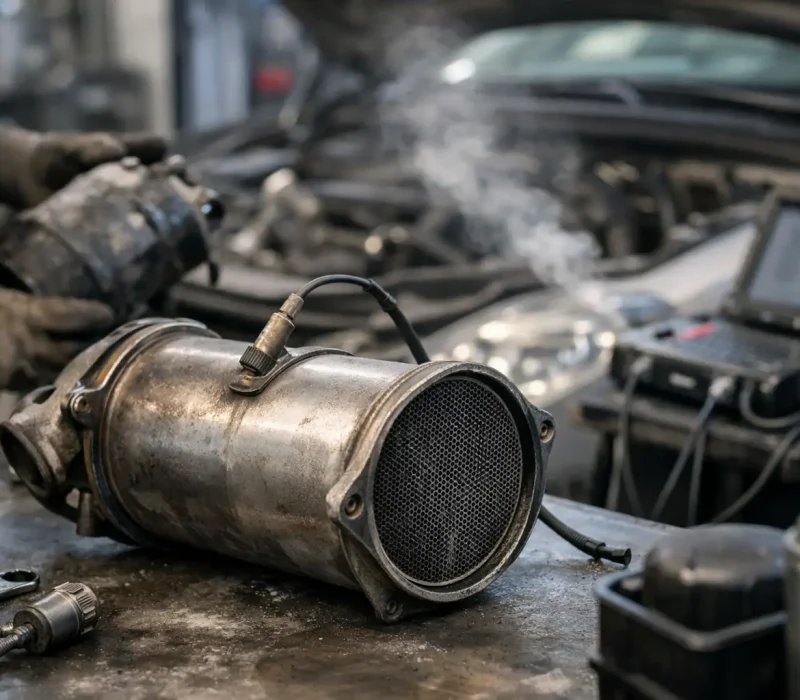
Forced regeneration is carried out with professional diagnostic equipment when the car can no longer complete a normal clean by itself. This is not the same as taking the vehicle for a fast drive and hoping for the best. A proper forced regeneration should only be done after checking for the fault that caused the blockage in the first place.
If there is a failed pressure sensor, an EGR fault, a boost leak, a stuck thermostat or an injector issue, forcing a regen without diagnosis can waste time and place extra stress on the system.
Why DPF problems happen in the first place
The DPF usually becomes a problem because something upstream is no longer allowing the engine to burn cleanly, or because the vehicle is not being driven in conditions that let regeneration complete properly.
Short journeys are a major factor. If the engine and exhaust never get properly hot, active regens are more likely to be interrupted. The soot load rises bit by bit until the warning light appears.
Driving style also plays a part. Diesels that spend most of their time idling, crawling through traffic or doing low-speed local work are more vulnerable than diesels used regularly on dual carriageways or for towing.
Then there are hardware and control issues. A faulty differential pressure sensor can give false readings. A thermostat stuck open can stop the engine reaching proper temperature. Carbon buildup in the EGR system can increase soot production. Turbo faults, injector imbalance and intake contamination can all contribute. In those cases, the DPF is not the root problem – it is the component showing the symptoms.
Warning signs you should not ignore
A DPF issue rarely starts with complete failure. Most vehicles give you a window to act before the problem becomes expensive.
The obvious sign is the DPF warning light, but there are others. The car may feel flat through the mid-range, fuel economy may dip, the engine cooling fans may run more often, or the stop-start system may stop working. In more advanced cases, you may see the engine management light, glow plug warning light on some models, or reduced power mode.
If the vehicle is trying to regenerate more frequently than normal, that is also a clue. A car that repeatedly attempts active regens every few days is often telling you that soot production is too high or that the cleaning process is not completing properly.
Guide to diesel DPF regeneration – what drivers can do first
If the warning has only just appeared and the vehicle is still driving normally, there may be a short opportunity to help the car complete a regeneration. That usually means a sustained run once the engine is fully warm, keeping revs and load steady rather than pottering about locally.
The exact driving conditions depend on the make and model, so there is no universal magic number. As a rough rule, 15 to 30 minutes of uninterrupted driving at suitable road speed can help some vehicles complete an active regeneration. If the car is already in limp mode, showing multiple warning lights or clearly overfilled with soot, that approach is less likely to work.
It is also worth checking basics. Using the correct low-SAPS engine oil matters because the wrong oil can contribute to ash buildup. Ignoring overdue servicing can make DPF issues more likely, not less.
What you should avoid is repeatedly clearing fault codes without fixing the cause, or relying on fuel additives as a cure-all. Some products have a place, but they are not a substitute for proper testing when the DPF is significantly loaded or the engine has an underlying fault.
When regeneration alone is not enough
There comes a point where the filter is too restricted for a normal burn-off to solve the problem safely. This is where diagnosis matters more than guesswork.
A proper assessment should look at soot loading, differential pressure readings, fault codes, exhaust temperature behaviour and the health of related components. If the numbers suggest the DPF is blocked but still structurally sound, a professional chemical clean can often restore flow far more effectively than repeated forced regenerations alone.
That distinction matters because excessive back pressure does not just affect the filter. It can hurt drivability, reduce MPG and place additional strain on the turbo and engine. Leaving the problem to get worse can turn a recoverable maintenance issue into a much bigger repair bill.
For drivers who rely on their vehicle for commuting, trade work or local fleet use, downtime is often the biggest cost. That is one reason mobile diagnostic and DPF cleaning support makes practical sense – the problem gets checked properly where the vehicle is parked, without adding the hassle of workshop drop-off.
The difference between a good fix and a quick fix
The best result comes from treating the cause, not just the warning light. If a diesel keeps blocking its DPF, there is nearly always a reason.
Sometimes the answer is straightforward. The car needs a proper clean and a change in driving pattern. Other times it is more technical – a sensor reading out of range, carbon-restricted airflow, a fuelling issue or a thermostat that never lets the engine reach ideal operating temperature.
At High REVS Performance, that is why DPF work is approached as a diagnostic service first, not a one-size-fits-all button press. The aim is to restore proper regeneration behaviour, improve reliability and help prevent the filter from blocking again a few weeks later.
Can you prevent repeat DPF problems?
Usually, yes, but prevention depends on how the vehicle is used. If your diesel mainly does short urban miles, it helps to give it regular longer runs where full operating temperature is maintained. Keeping servicing up to date, using the correct oil and dealing with EGR, boost or thermostat faults early also makes a real difference.
For high-mileage drivers and light commercial users, prevention is often about not ignoring the early signs. A slight drop in economy, frequent regen behaviour or a new hesitation under load may be the first indicator that the engine is producing more soot than it should.
For some owners, it is also worth asking whether the vehicle’s use still matches a diesel with DPF equipment. Modern diesels are excellent when used correctly, especially for motorway work, towing and longer-distance driving. They are less forgiving when they spend most of life on cold, interrupted journeys.
A DPF warning light does not always mean you need a new filter, and it does not always mean a quick drive will sort it either. The right answer depends on soot load, fault history, engine condition and how the vehicle is actually being used. Catch it early, get it checked properly, and you give yourself the best chance of avoiding the kind of repair that really does take the car off the road.


Comments (04)